Kenyan schools offer one national curriculum, CBC (now called CBE), and several international ones: Cambridge IGCSE and A level, Pearson Edexcel and the British National Curriculum, Montessori for the early years, the International Baccalaureate (IB) and American programmes. The old 8-4-4 system is closing: KNEC has said 2027 is the last chance to sit KCSE under it.
Quick answer: The current curriculum in Kenya is CBC/CBE, the national curriculum from pre-primary to Grade 12 in a 2-6-3-3 structure. International curricula such as Cambridge and Pearson Edexcel lead to IGCSE and A level, and are common in private and international schools. Montessori is an approach for young children rather than a full school system. No curriculum is “best”: the right one depends on your child, your plans and whether you can keep them in it to the end.
What is the current curriculum in Kenya?
CBC, the Competency Based Curriculum, which the Ministry of Education has called Competency Based Education (CBE) since 24 April 2025. It is the same system under a newer name. KICD describes its structure as 2-6-3-3: two years of pre-primary, six of primary, three of junior school and three of senior school. The first senior school class joined Grade 10 in January 2026.
Which curricula are offered in Kenya?
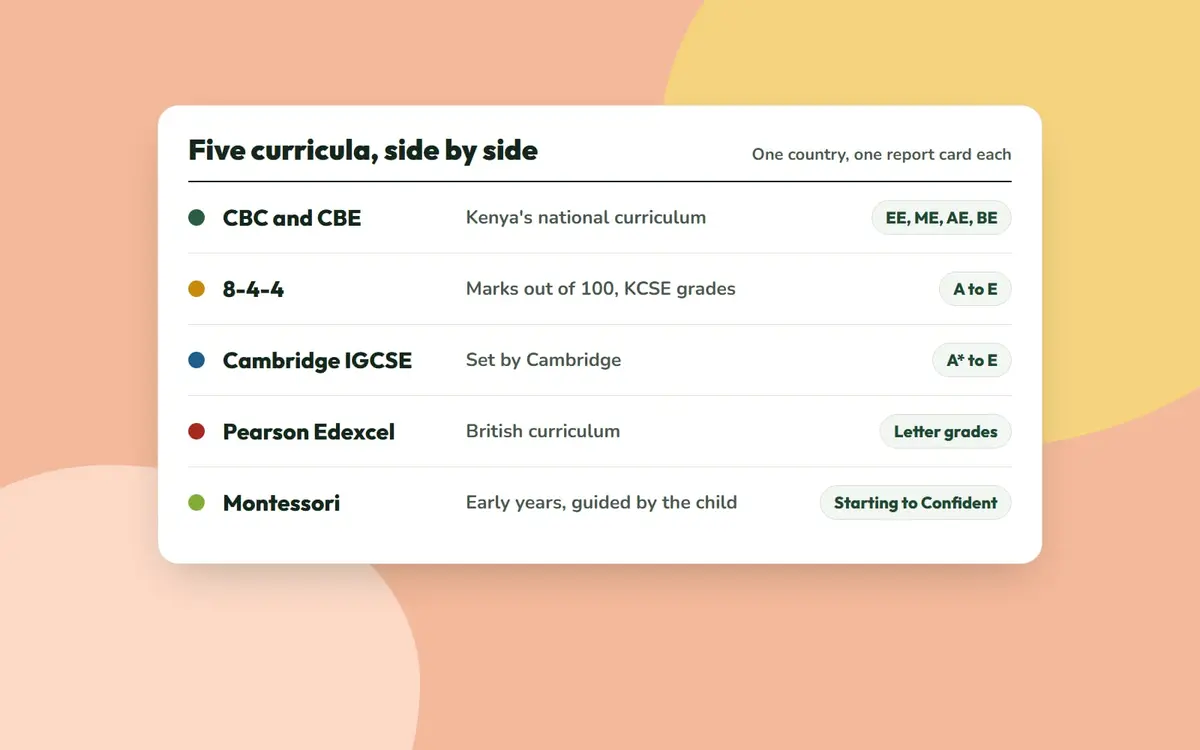
Here is every curriculum you are likely to meet when you look at schools in Kenya, side by side.
| Curriculum | Ages and stages | Main exams | Who sets it | Often suits |
|---|---|---|---|---|
| CBC/CBE | PP1 to Grade 12 (2-6-3-3) | KPSEA (Grade 6), KJSEA (Grade 9), then a senior school assessment (the first class finishes Grade 12 in 2028) | KICD (curriculum) and KNEC (assessment), Kenya | Families planning to stay in the Kenyan system and Kenyan universities |
| 8-4-4 | Form classes and repeat candidates only (closing) | KCSE | KNEC, Kenya | Only learners already in the last Form classes |
| Cambridge | Primary, Lower Secondary, IGCSE (14 to 16), AS and A level | Cambridge IGCSE, AS and A level | Cambridge International, UK | Families wanting an international qualification recognised abroad and in Kenya |
| Pearson Edexcel / British | Key stages from age 5, International GCSE, International A level | Pearson Edexcel International GCSE and International A level | Pearson, UK | Similar families; schools that like Edexcel’s modular options |
| Montessori | Mostly early years in Kenya; AMI sets standards from birth to 18 | None of its own | Montessori bodies such as AMI train teachers and set classroom standards | Young children who learn well with hands on, self paced work |
| IB | Four programmes for ages 3 to 19 | IB Diploma | International Baccalaureate | Families moving between countries, or wanting a broad pre-university programme |
| American | Kindergarten to Grade 12 | High school diploma, often with SAT or AP | Individual schools and US accrediting bodies | Families aiming for universities in the United States |
Cost depends far more on the school than on the curriculum, but international exam entries, imported books and smaller classes usually make international curricula cost more. We do not quote fees here: ask each school for a written fee structure.
CBC (now CBE): the national curriculum
In CBC/CBE, learners are rated EE, ME, AE or BE rather than given A to E grades. Grade 9 ends with KJSEA, the Kenya Junior School Education Assessment, which feeds national placement into senior school. In senior school each learner follows one pathway: STEM, Social Sciences, or Arts and Sports Science, each split into tracks.
Read more: CBC vs CBE: is CBC now CBE?, the CBC grading system, CBC report card comments and senior school pathways under CBE.
8-4-4: closing in 2027
8-4-4 had eight years of primary, four of secondary and four of university, and was first examined at KCSE in 1989. No new class is starting it. KNEC’s chief executive, David Njengere, has said 2027 is the last chance to complete or repeat KCSE under 8-4-4. If your child is in a Form class now, they finish in 8-4-4. Everyone else is in CBC/CBE or an international curriculum.
Read more: the 8-4-4 grading system.
CBC vs 8-4-4: the main differences
| CBC/CBE | 8-4-4 | |
|---|---|---|
| Structure | 2-6-3-3 | 8 years primary, 4 secondary |
| Grading | Performance levels (EE, ME, AE, BE) | Letter grades A to E and points |
| End of school | Senior school pathways, Grade 10 to 12 | KCSE in Form 4 |
| Status | Current national curriculum | Last KCSE chance in 2027 |
Cambridge IGCSE and A level
Cambridge IGCSE is, in Cambridge’s words, the world’s most popular international qualification for 14 to 16 year olds, with over 70 subjects to choose from. In Kenya it is graded A* to G. After IGCSE, many learners take Cambridge International AS and A levels, usually over two years. Many Cambridge schools also run Cambridge Primary and Lower Secondary first, using Year groups rather than Grades.
Read more: Cambridge IGCSE in Kenya and, if your child is changing systems, moving from CBC to IGCSE.
Pearson Edexcel and the British curriculum
The British National Curriculum is organised in key stages, from Key Stage 1 (ages 5 to 7) to Key Stage 4 (ages 14 to 16). Schools in Kenya that call themselves “British curriculum” usually follow it in the younger years, then enter learners for Pearson Edexcel International GCSE and International A level, or for Cambridge. Pearson’s International GCSEs are graded 9 to 1, with exams in May and June and in November.
Read more: Pearson Edexcel and the British curriculum.
Montessori
Montessori is a way of teaching built on mixed age classes, hands on materials and long, uninterrupted work periods. AMI (Association Montessori Internationale) publishes classroom standards for ages 0 to 12 and 12 to 18. In Kenya you will mostly find it in the early years, alongside or before CBC/CBE pre-primary or an international curriculum.
Read more: Montessori in Kenya.
IB and American curricula
The International Baccalaureate offers four programmes for learners aged 3 to 19: the Primary Years Programme (3 to 12), the Middle Years Programme (11 to 16), and the Diploma Programme and Career-related Programme (both 16 to 19). The Diploma is the one universities look at.
American curriculum schools run from kindergarten to Grade 12 and award a high school diploma, often alongside SAT scores or Advanced Placement (AP) courses. They suit families who plan for universities in the United States.
Some international schools in Kenya offer one or both. Ask each school which programmes it is authorised or accredited to teach.
Is IGCSE better than KCSE or CBC?
Not in general. Each is a full route to university for the right child. Kenyan universities admit learners with KCSE and with international qualifications, but international certificates must be equated by KNEC, and each university sets its own entry rules. The first CBC/CBE senior school class finishes in 2028. What matters more is fit, cost you can sustain, and where your child may study next. Our guide on which curriculum is best for my child walks through it.
Dual curriculum schools
Many Kenyan private schools run two curricula. The most common pairs are CBC/CBE alongside Cambridge or Pearson Edexcel, often with Montessori in the early years. Some let parents choose a track for each child; others run the national curriculum to a certain class and then move learners to IGCSE.
If you are looking at a dual curriculum school, ask:
- Which curriculum will my child be in, and from which class to which class?
- Is there a point where learners must choose, and can they switch back?
- Are the two tracks taught by different teachers?
- Which exams will my child sit, and at which centre?
For schools running more than one curriculum, see a school system for multiple curricula.
How to tell which curriculum a school follows
A school’s name can say “International” or “Academy” and still teach CBC/CBE. Check:
- Class names. PP1, PP2 and Grade 1 to Grade 12 usually mean CBC/CBE. Year 1 to Year 13 usually mean British or Cambridge.
- Exam board registration. A school that enters learners for Cambridge or Pearson exams is registered with that board as an exam centre. Ask for its centre number.
- Report cards. CBC/CBE reports show EE, ME, AE and BE. IGCSE reports show letter or number grades.
- Books. Ask to see the textbooks for your child’s class.
- Registration. Every school in Kenya, whatever its curriculum, should be registered with the Ministry of Education.
How Enaton helps
For school owners and principals: Enaton runs five curricula in one system, each on its own terms: CBC/CBE, 8-4-4, Cambridge (IGCSE, AS and A level), Pearson Edexcel and British (key stages, International GCSE and A level) and Montessori. Enaton does not run IB or American programmes. A dual curriculum school keeps one learner register, one fee system and one parent account per family, and every module comes from the first day. See Enaton for head teachers and Enaton for school owners, or book a demo. A parent? See what Enaton gives parents, and share this guide with your child’s head teacher.
Frequently asked questions
What is the main curriculum in Kenya?
CBC, now called CBE (Competency Based Education). It is the national curriculum for basic education, from pre-primary to Grade 12, in a 2-6-3-3 structure.
How many curricula are there in Kenya?
One national curriculum, CBC/CBE, with 8-4-4 closing. Alongside it, schools offer international curricula: mainly Cambridge, Pearson Edexcel and the British National Curriculum, Montessori in the early years, and at some international schools IB or American programmes.
Is 8-4-4 still offered?
Only to learners already in a Form class and to repeat candidates. KNEC has said 2027 is the last chance to sit KCSE under 8-4-4.
Which curriculum is best in Kenya?
None is best for every child. Think about how your child learns, where they may go to university, and whether you can keep them in the same curriculum to the end.
What is a dual curriculum school?
A school that offers two curricula, most often CBC/CBE alongside Cambridge or Pearson Edexcel. Ask which one your child will follow and when, if ever, they must choose.
Can my child join a Kenyan university with IGCSE or A level?
Many do. International certificates are equated by the Kenya National Examinations Council (KNEC), and each university sets its own entry rules. Check with KNEC and the university before your child chooses.
Sources
- Kenyans.co.ke, “Ministry of Education Changes CBC to CBE”, 25 April 2025: kenyans.co.ke
- People Daily, “Grade 9 won’t be moved, says KICD” (the 2-6-3-3 structure), 8 March 2024: peopledaily.digital
- Ministry of Education, Press Statement, “Academic Year 2026 Commencement Update”, 2 January 2026: education.go.ke
- The Eastleigh Voice, “KNEC gives Kenyans until 2027 to resit KCSE exams before end of 8-4-4 system”, 27 August 2025: eastleighvoice.co.ke
- Cambridge International, Cambridge IGCSE: cambridgeinternational.org
- Pearson, Edexcel International GCSEs: qualifications.pearson.com
- UK Government, The national curriculum: gov.uk and key stages 3 and 4: gov.uk
- AMI USA, Standards for AMI Montessori classrooms: amiusa.org
- International Baccalaureate, Education programmes: ibo.org
- University of Nairobi, “Procedure for Equation of Foreign Qualifications”: uonbi.ac.ke