Yes, CBC is now CBE. On 24 April 2025 the Ministry of Education launched the name Competency Based Education (CBE) for what had been the Competency Based Curriculum (CBC), and presented it as a review of some aspects of CBC under a new brand.
Quick answer: CBE is the same competency based system your child was already in: the same grades, the same learning areas and the same EE, ME, AE and BE performance levels. What changed is the name, Mathematics in senior school, and the arrival of senior school itself. The first Grade 9 class sat KJSEA in late 2025 and joined Grade 10 in January 2026, where each learner follows one of three pathways. The second class sits KJSEA from 26 October 2026 and joins Grade 10 in 2027.
What is CBE in full?
CBE stands for Competency Based Education. CBC stands for Competency Based Curriculum. Both describe the system Kenya brought in to replace 8-4-4, where learners are judged on what they can do rather than on a single percentage mark.
When people search “what is CBE in education in Kenya”, this is the answer: it is the national system for basic education, from pre-primary to senior school, under its newer name.
Why did CBC change to CBE?
According to Kenyans.co.ke, the then Basic Education Principal Secretary Julius Bitok launched the new name on Thursday 24 April 2025 at the National Conversation Forum on Education at KICC, Nairobi. He said a curriculum is dynamic, that the Ministry had a chance to review some aspects of it, and that it was “officially launching the new brand from CBC to CBE”.
The aims reported at the launch were to simplify the learning pathways and to make education more affordable, accessible and practical, with more focus on each learner’s strengths, interests and practical skills. The Ministry also spoke of more teacher training and better facilities for technical, arts and sports education.
You will read other explanations online, for example that the name was changed to match countries such as Finland or Singapore. We could not find the Ministry saying that, so we do not repeat it. Our own reading is simpler: “curriculum” means what is taught, while “education” also covers assessment, placement and the move between levels, which is where most of the 2025 changes sit. Treat that as our explanation, not an official one.
CBC vs CBE: what is the difference?
For a parent, the honest answer is: very little in the classroom, and a lot in the words you will hear.
| What stayed the same | What changed | |
|---|---|---|
| Structure | Pre-primary, primary, junior school and senior school (2-6-3-3) | Senior school began with Grade 10 in January 2026; the first class reaches Grade 12 in 2028 |
| Assessment | EE, ME, AE and BE performance levels, and school based assessment | Grade 9 learners sit KJSEA, and it feeds senior school placement |
| Learning | Learning areas, strands and sub strands | Senior school runs in three pathways, each split into tracks |
| Mathematics | Still taught to every learner | Compulsory in senior school: STEM learners take pure Mathematics, others a simpler form |
| Schools | Every CBC school is a CBE school | Senior schools are grouped by the pathways they offer (triple or dual pathway) |
| The name | “CBE” in Ministry notices; “CBC” still used by most parents and many schools |
So if your child’s report card still says CBC, nothing is wrong. Many schools, publishers and parents use both words, and “CBC/CBE” is common.
Is CBE a new curriculum?
No. It is the same system with some parts reviewed. Your child does not repeat a class, change books for the sake of the name or sit any extra test because of it. The changes that matter are the ones above: senior school pathways, Mathematics in senior school and KJSEA leading to placement.
How the CBC/CBE structure works
KICD’s chief executive, Prof Charles Ong’ondo, explained the structure as 2-6-3-3 in People Daily:
- Pre-primary: two years (PP1 and PP2).
- Primary: six years (Grade 1 to Grade 6).
- Junior school: three years (Grade 7 to Grade 9).
- Senior school: three years (Grade 10 to Grade 12).
Primary ends with KPSEA in Grade 6. Junior school ends with the Kenya Junior School Education Assessment (KJSEA) in Grade 9, which is KNEC’s name for it (some newspapers write “Junior Secondary”). KJSEA is reported in performance levels rather than a total mark. We explain the levels and points in our guide to the CBC grading system in Kenya, and the comments teachers write in our guide to CBC report card comments.
The CBE timeline parents need to know
The first full run, as reported by the Ministry and the press:
- 24 April 2025: the Ministry launches the CBE name.
- 9 to 30 June 2025: Grade 9 learners choose a pathway, subject combinations and 12 senior schools on the Ministry’s selection platform (The Standard).
- 27 October to 3 November 2025: the first KJSEA (Capital FM).
- 11 December 2025: KJSEA results released (The Star).
- 19 December 2025: Grade 10 placements released, with a review window from 23 December (Capital FM).
- 29 December 2025: the first revision of placements completed; joining instructions on placement.education.go.ke from 30 December (Ministry of Education).
- 6 to 9 January 2026: a further window to ask for a placement review (Ministry of Education).
- 12 January 2026: Grade 10 learners report to senior school (Ministry of Education).
The second class is now going through the same steps:
- September 2026: Grade 9 selection opened on Monday 7 September for about 1.2 million learners, with the number of school choices cut from 12 to eight (Nation).
- 26 to 30 October 2026: the written KJSEA papers, after project work from May to July (KNEC’s revised 2026 timetable).
- 2027: this class joins Grade 10.
Senior school pathways and Grade 10 placement
Senior school is where CBE looks most different from 8-4-4. Each learner follows one of three pathways, and the Ministry’s selection portal splits each into tracks:
| Pathway | Tracks |
|---|---|
| STEM | Pure Sciences, Applied Sciences, Technical Studies |
| Social Sciences | Languages and Literature, Humanities and Business Studies |
| Arts and Sports Science | Arts, Sports Science |
Not every school offers every pathway: triple pathway schools offer all three, dual pathway schools two. Placement uses the learner’s choices, their results and the space each school has. For the full picture, read our guide to senior school pathways under CBE.
The words schools now use
- Learning areas: what CBC/CBE calls subjects.
- Strands and sub strands: the topics inside a learning area.
- Performance levels: EE (Exceeding Expectations), ME (Meeting Expectations), AE (Approaching Expectations) and BE (Below Expectations).
- School based assessment: work your child is assessed on in class through the year.
- KPSEA: the assessment at the end of primary, in Grade 6.
- KJSEA: the assessment at the end of junior school, in Grade 9.
- Pathway, track and subject combination: what a learner studies in senior school.
- Selection and placement: choosing senior schools in Grade 9, then the national allocation of a place.
What should parents do now?
- Do not worry about the name. CBC and CBE are the same system.
- Keep an eye on school based assessment. It counts, so ask how your child is doing during the year, not only at the end.
- Start the pathway conversation early. Grade 7 and Grade 8 are the years to notice what your child enjoys and does well.
- Know the dates. Selection comes in Grade 9, KJSEA towards the end of the year, placement after the results.
- Use official channels. The Ministry of Education, KNEC and your child’s school, not forwarded messages. The Ministry’s selection portal says it never asks for payment to select or be placed.
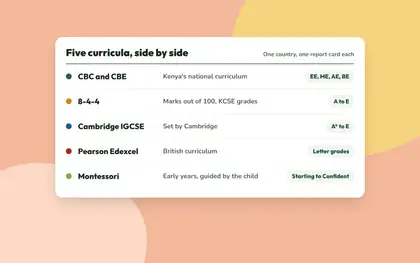
If your child is in 8-4-4, that system is closing: KNEC’s chief executive has said 2027 is the last chance to sit or repeat KCSE under 8-4-4. Our 8-4-4 grading system guide covers KCSE grades. For the whole picture, including Cambridge and Pearson Edexcel, see curricula in Kenya explained.
How Enaton helps
The name changed; the records a school keeps did not. Enaton runs CBC/CBE end to end: learning areas, strands and sub strands, school based assessment through the year, and report cards parents read on the portal. Junior and senior school sit in one system with fees, attendance, timetable and communication, and learner records stay ready for KEMIS. See the CBC school management system or Enaton for head teachers, or book a demo. A parent? See what Enaton gives parents, and share this guide with your child’s head teacher.
Frequently asked questions
Is CBC now CBE?
Yes. Since 24 April 2025 the Ministry of Education has used the name Competency Based Education for the Competency Based Curriculum. It is the same system, with some parts reviewed.
What is the difference between CBC and CBE in Kenya?
In the classroom, very little: the grades, learning areas and performance levels are the same. The differences are the name, compulsory Mathematics in senior school (pure Mathematics for STEM, a simpler form for the other pathways) and senior school pathways, which started in January 2026.
Why did CBC change to CBE?
At the launch the Ministry said it was a review of some aspects of CBC under a new brand, to simplify pathways and make education more affordable, accessible and practical.
Does my child need to change school because of CBE?
No. Every school that offered CBC now offers CBE. The only big move is from junior school to senior school after Grade 9, through national selection and placement.
When is KJSEA 2026?
KNEC’s revised timetable sets the written papers from Monday 26 October to Friday 30 October 2026, after project work in Creative Arts and Sports, Pre-Technical Studies and Agriculture between May and July.
Is 8-4-4 still running?
Only for the last secondary classes and repeat candidates. KNEC’s chief executive has said 2027 is the last chance to sit or repeat KCSE under 8-4-4.
Will report cards still show EE, ME, AE and BE?
Yes. Those four performance levels are still how CBC/CBE reports achievement, and KNEC splits them into eight sub levels for KJSEA.
Sources
- Kenyans.co.ke, “Ministry of Education Changes CBC to CBE”, 25 April 2025: kenyans.co.ke
- People Daily, “Grade 9 won’t be moved, says KICD”, 8 March 2024: peopledaily.digital
- The Standard, “Grade 9 learners begin choosing senior school pathways under CBC”, 9 June 2025: standardmedia.co.ke
- Capital FM, “Bitok promises KJSEA results by Dec 11, Grade 10 choices before Christmas”, 17 November 2025: capitalfm.africa
- The Star, “EXPLAINER: How to access Grade 10 placement results”, 20 December 2025: the-star.co.ke
- Capital FM, “KJSEA Grade 10 placement: How to review placement choice as deadline draws near”, 25 December 2025: capitalfm.africa
- Ministry of Education, Press Statement, “Academic Year 2026 Commencement Update”, 2 January 2026: education.go.ke
- Ministry of Education, Grade 10 Selection and Placement portal, pathways: selection-and-placement.kemis.go.ke
- Nation, “Grade 9 learners get fewer school choices as senior selection opens”, 8 September 2026: nation.africa
- KNEC, Revised 2026 KJSEA Timetable and Instructions (archived 9 September 2026): web.archive.org
- The Eastleigh Voice, “KNEC gives Kenyans until 2027 to resit KCSE exams before end of 8-4-4 system”, 27 August 2025: eastleighvoice.co.ke