The CBC grading system in Kenya reports each learner’s achievement in four performance levels: Exceeding Expectations (EE), Meeting Expectations (ME), Approaching Expectations (AE) and Below Expectations (BE). For the Kenya Junior School Education Assessment (KJSEA), KNEC splits each level into two, giving an eight point scale from EE1 (8 points) down to BE2 (1 point).
Quick answer: CBC does not use A to E grades. Learners are rated EE, ME, AE or BE in each learning area; in classroom assessment KNEC numbers these Level 4 down to Level 1. At KJSEA the levels become eight sub levels (EE1, EE2, ME1, ME2, AE1, AE2, BE1, BE2), worth 8 down to 1 point, and each learning area is reported on its own, with no total and no mean grade from KNEC.
What are the CBC grading levels?
Under the Competency Based Curriculum, assessment asks “can the learner do this?” rather than “what percentage did they get?”. KNEC’s Competency Based Assessment Framework records each task on one of four performance levels:
| Level | Code | Classroom level | What it means in plain words |
|---|---|---|---|
| Exceeding Expectations | EE | Level 4 | The learner does more than the expected standard, consistently and independently. |
| Meeting Expectations | ME | Level 3 | The learner has achieved the expected standard. |
| Approaching Expectations | AE | Level 2 | The learner is partly there and needs more support or practice. |
| Below Expectations | BE | Level 1 | The learner has not yet reached the standard and needs significant support. |
The level names, codes and Level 4 to Level 1 numbering are KNEC’s. The plain word explanations are ours, written to help parents. This four level scale is what most primary school report cards use, which is why you may see “4” or “EE” for the same result.
The CBC 8 point scale: EE1 to BE2
When the first KJSEA results were released on 11 December 2025, Education Cabinet Secretary Julius Ogamba explained that each of the four levels is split into two, so results are reported from point 1 to point 8, with 8 the best. The score bands announced at the release were:
| Sub level | Score band | Points | Remark reported at release |
|---|---|---|---|
| EE1 | 90 to 100% | 8 | Exceptional |
| EE2 | 75 to 89% | 7 | Very good |
| ME1 | 58 to 74% | 6 | Fair |
| ME2 | 41 to 57% | 5 | Fair |
| AE1 | 31 to 40% | 4 | Needs improvement |
| AE2 | 21 to 30% | 3 | Below average |
| BE1 | 11 to 20% | 2 | Way below average |
| BE2 | 1 to 10% | 1 | Minimal |
The bands are as reported by The Star and Education News from the release, and the remarks as reported by The Star; KNEC confirmed the four levels, the split into eight and the EE1 = 8 and BE2 = 1 endpoints in its own statement. Bands may be revised for later years, so check the latest KNEC circular before using them for anything that matters.
What does “7 EE2” mean on a KJSEA result?
The number in front is the points and the code after it is the sub level. “7 EE2” means the learner scored in the 75 to 89% band in that learning area and is Exceeding Expectations. “5 ME2” means 41 to 57%, Meeting Expectations. “4 AE1” means 31 to 40%, Approaching Expectations. Read each learning area on its own.
How the KJSEA result is put together
KJSEA is not only the Grade 9 papers. According to The Star’s report of the release, each learner’s result combined 20% from KPSEA (the Grade 6 assessment), 20% from school based assessment in Grades 7 and 8, and 60% from the KJSEA itself, which was sat from 27 October to 3 November 2025. KNEC’s user guide confirms that KJSEA covers the work of Grades 7, 8 and 9, uses multiple choice and structured questions, and that school based assessments contribute to the reported result.
CBC grading system points: are they added up?
This is the question parents ask most, because 8-4-4 taught everyone to think in totals. KNEC’s position is clear: KJSEA “does not provide an aggregate score”. Each learning area is assessed independently and reported using performance levels, so a child’s excellence in one area is not hidden by a weaker one. KNEC also said there is no school mean score, and described a circulating results analysis that ranked schools by totals as fake.
You will still read that the maximum is “72 points” (8 points in each of the nine learning areas a learner is reported on). That is simple arithmetic some reports used, not a KNEC aggregate. If a school adds points for its own tracking, that is the school’s choice; it is not how KNEC reports.
Is AE a pass?
There is no pass or fail in the KCSE sense. At the 2025 release the Cabinet Secretary said an Approaching Expectations result is sufficient for learners to progress to senior school pathways that need basic competencies in that learning area. Pathway choices, results and school capacity then guide placement; see our guide to senior school pathways under CBE.
How report cards show CBC grades
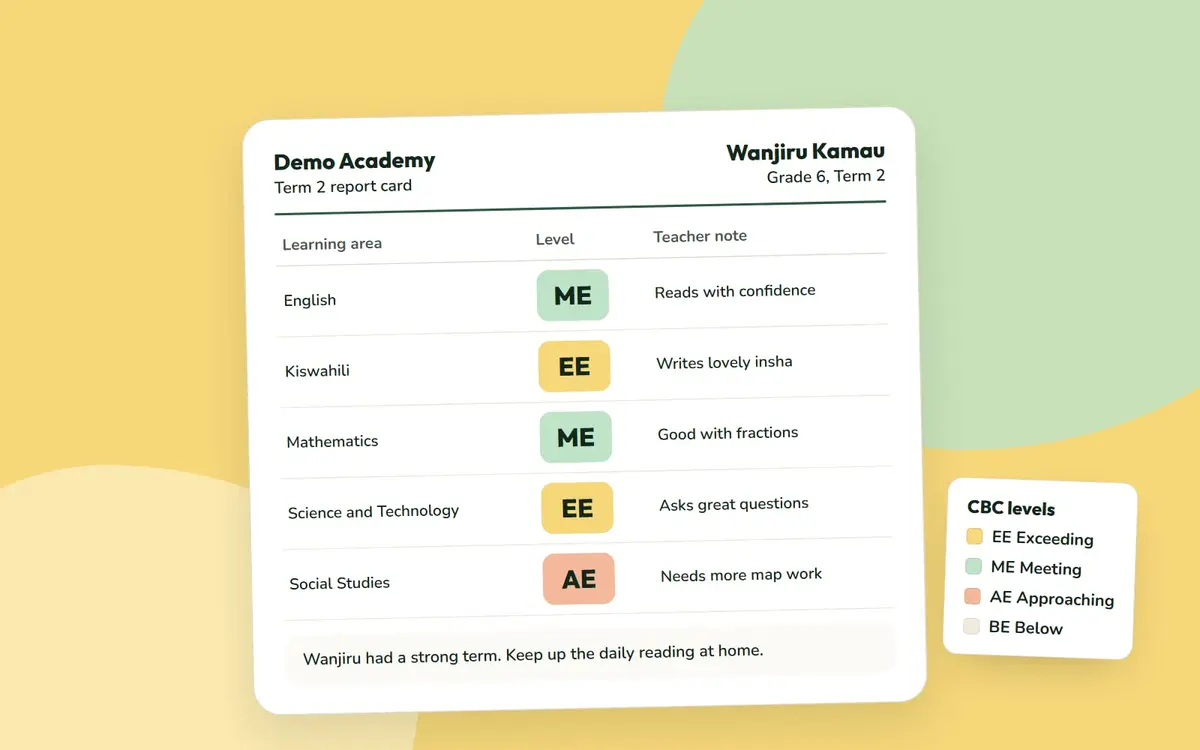
KNEC’s framework says the school issues a School Year Report to every learner in each grade, with both qualitative and quantitative information in each learning area. A typical term or year report shows:
- Each learning area (for example English, Kiswahili, Mathematics, Integrated Science, Creative Arts and Sports) with the performance level achieved.
- Strands or sub strands within a learning area, where the school reports at that depth, each with its own level.
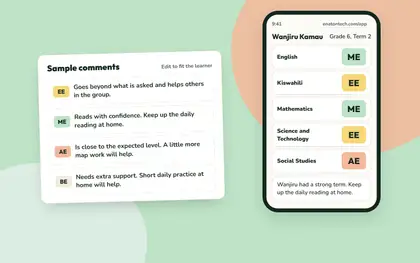
- The teacher’s comment describing what the learner can do and what to work on next.
- Core competencies and values, such as communication and collaboration, critical thinking and responsibility, often with their own short rating.
- Attendance and the class teacher’s and head teacher’s remarks.
Because a level is a description rather than a number, the comment matters more than it did under 8-4-4. “ME” tells a parent their child is on track; the comment tells them what that means. Our guide to CBC report card comments has examples for every level.
Why some learners show a number and others do not
Some report cards show only the four levels, or 4 to 1. Junior school reports often also show the sub level and points, because those are what KNEC uses at KJSEA. Both describe the same scale at different levels of detail.
CBC vs CBE: what changed?
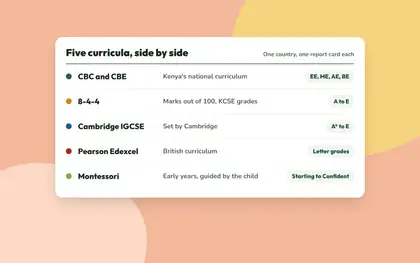
You will now see CBE, Competency Based Education, in Ministry and KNEC documents, alongside or instead of CBC, the Competency Based Curriculum. KNEC’s own 2025 KJSEA user guide uses “Competency Based Education”. The performance levels above did not change with the name. Our guide CBC is now CBE explains the change, and curricula in Kenya explained puts CBC/CBE beside 8-4-4, Cambridge and the rest.
Grading under CBC compared with 8-4-4
| CBC/CBE | 8-4-4 | |
|---|---|---|
| What is graded | Competence in each learning area | Marks in each subject |
| How it is shown | EE, ME, AE, BE (Level 4 to 1), and EE1 to BE2 at KJSEA | A to E, worth 12 to 1 points |
| Overall result | No aggregate, total or mean grade from KNEC at KJSEA | Mean grade from seven subjects |
| What feeds the national result | KPSEA, school based assessment and KJSEA | The KCSE exam |
Our guide to the 8-4-4 grading system covers KCSE points and mean grades in detail.
How Enaton helps
Enaton runs CBC, now called CBE, the way it is built: learning areas, strands, sub strands and competency based grading. Teachers record an assessment once and the report card follows, printed or released to parents on the portal. 8-4-4 and Cambridge classes run in the same system, alongside fees, attendance and transport, so the school keeps one record per learner. See the CBC school management system and the school report card system, read what Enaton does for teachers and for parents, or book a demo. Want this at your child’s school? Share this guide with the head teacher, or tell them about Enaton.
FAQ
What are the four CBC grading levels?
Exceeding Expectations (EE), Meeting Expectations (ME), Approaching Expectations (AE) and Below Expectations (BE). In classroom assessment KNEC numbers them Level 4, 3, 2 and 1.
What is EE1 in CBC?
EE1 is the top sub level of Exceeding Expectations on KNEC’s eight point KJSEA scale. It carries 8 points and, at the 2025 release, covered scores of 90 to 100%. EE2, the next level, carries 7.
What does ME2 mean in KJSEA?
ME2 is the lower half of Meeting Expectations. It carries 5 points and covered 41 to 57% at the 2025 release. The learner has met the expected standard in that learning area.
Does CBC have a mean grade?
Not from KNEC at KJSEA. KNEC stated that KJSEA results have no aggregate score, no total points and no mean grade, and that each learning area is reported separately using performance levels.
How many marks is Exceeding Expectations?
At the 2025 KJSEA release, Exceeding Expectations covered 75 to 100%: EE2 for 75 to 89% and EE1 for 90 to 100%. In school assessments the teacher judges the level against the rubric for each task, so check how your school sets its bands.
What is the difference between CBC and CBE?
CBC is the Competency Based Curriculum; CBE, Competency Based Education, is the name now used by the Ministry and KNEC. The performance levels KNEC reports are the same four, EE, ME, AE and BE.
What does ME mean on a CBC report card?
ME means Meeting Expectations: the learner has achieved the expected standard in that learning area. ME1 and ME2 are its two sub levels at junior school.
Sources
- Kenya National Examinations Council, Competency Based Assessment Framework, Age Based (Regular), section 5.2 on the School Year Report and the four performance levels: knec.ac.ke
- Kenya National Examinations Council, User Guide for the Management and Administration of KPSEA and KJSEA, 2025 edition: knec.ac.ke
- The Star, “KNEC explains new KJSEA grading system”, 15 December 2025: the-star.co.ke
- The Star, “How candidates were graded in KJSEA”, 11 December 2025: the-star.co.ke
- The Star, “Explainer: Inside the new CBE grading system”, 13 December 2025: the-star.co.ke
- Capital FM, “KJSEA 2025 grading explained: What parents must know”, 11 December 2025: capitalfm.africa
- Education News, “Beyond the marks: A clear guide to interpreting KJSEA results”, 12 December 2025: educationnews.co.ke