A good CBC report card comment says what the learner can do, gives one piece of evidence, and names one next step, in two or three plain sentences. Below are comments for each performance level (EE, ME, AE, BE) and for the main learning areas, written for Kenyan teachers to adapt, not copy word for word.
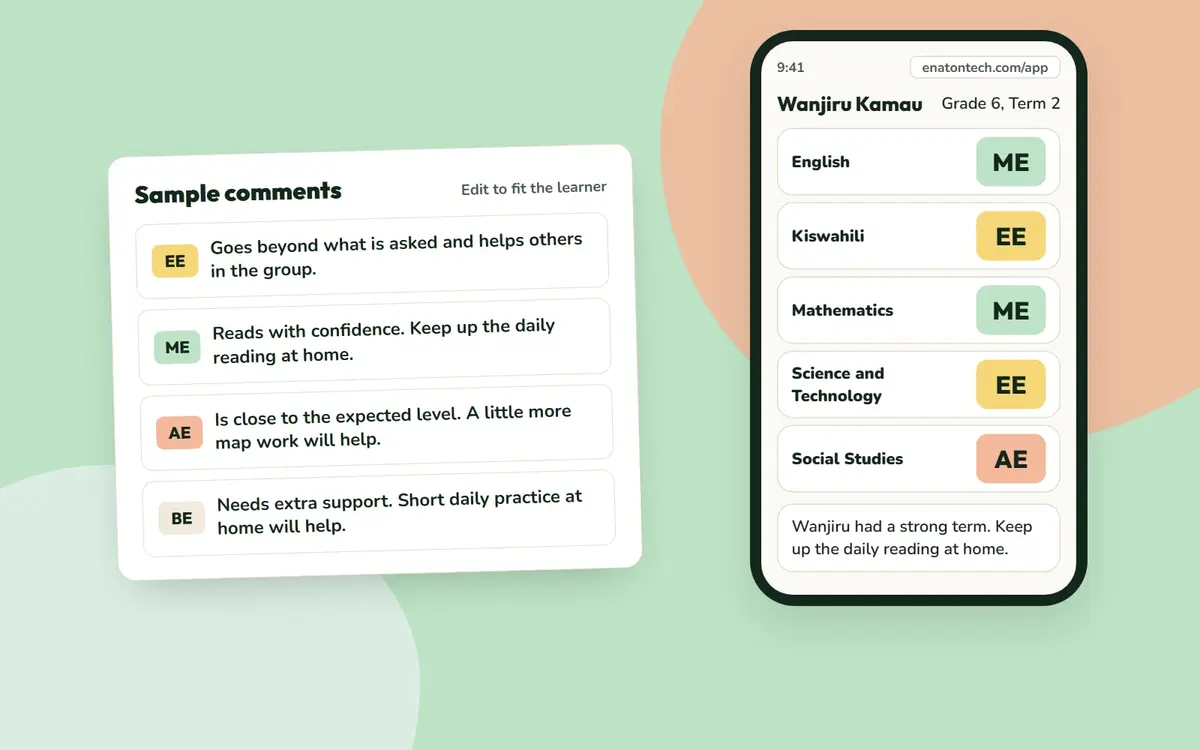
Quick answer: Use the pattern can do + evidence + next step. For example: “Reads Grade 4 texts fluently and retells the main events in order. Next, she should practise answering ‘why’ questions about what she reads.” Match the tone to the level, keep it specific, and avoid comments that could describe any child.
Why CBC comments matter more than 8-4-4 remarks
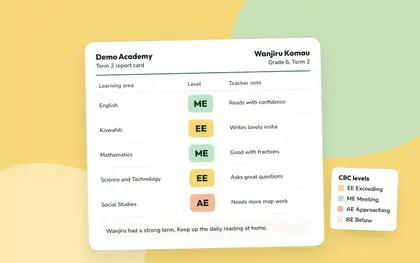
Under 8-4-4, a mark did most of the talking and the remark could be “Good work, keep it up”. Under CBC/CBE the result is a performance level, such as ME, and a level on its own tells a parent very little. The comment is where the report card explains what “Meeting Expectations” means for this child, this term, in this learning area.
Parents read comments closely. A vague one wastes the only line a busy parent will act on; a specific one tells them what to practise at home.
It is also what KNEC asks for. Its Competency Based Assessment Framework says the School Year Report, which every learner gets at the end of each grade, should carry both qualitative and quantitative information in each learning area, and that an assessment record should include a statement on the learner’s performance “citing the strengths and suggested strategies for improvement”. A comment is that statement. If you need a refresher on what each level means, see our guide to the CBC grading system in Kenya.
How to write a useful CBC report card comment
- Start with what the learner can do. Lead with a strength, even at BE. “Can count objects to 20 accurately” is a real starting point.
- Give evidence. Name the task or activity: a project, an oral presentation, a practical, a class exercise.
- Name one next step. Make it something a parent could help with.
- Use the learner’s name or the right pronoun, and check it before printing.
- Avoid labels. Describe the work, not the child: “has not yet completed” rather than “is lazy”.
- Keep it short. Two or three sentences per learning area is enough.
Words that help, and words to avoid
Helpful: can, consistently, with support, independently, is beginning to, next, practise, explain, show.
Avoid: weak, poor, lazy, careless, slow, always, never. These judge the child, do not help a parent act, and are hard to defend at a meeting.
CBC report card comments by performance level
These are templates. Replace the bracketed parts with the real skill and evidence.
Exceeding Expectations (EE) comments
- “[Name] consistently goes beyond what is expected in [learning area]. In [task], she [specific achievement]. Next, she can take on [harder challenge] to keep stretching herself.”
- “Works independently and explains his reasoning clearly. His [project or activity] was among the most thorough in the class. He is ready to help classmates and to try [extension task].”
Meeting Expectations (ME) comments
- “[Name] has achieved the expected standard in [learning area]. He can [skill] accurately, as shown in [task]. Next, he should work on [specific next step] to move towards exceeding expectations.”
- “Completes tasks carefully and participates well in group work. She understands [topic]; with more practice in [area] she will be more confident.”
Approaching Expectations (AE) comments
- “[Name] is making progress in [learning area] and can now [skill] with some support. He still finds [specific difficulty] hard. Short daily practice in [activity] will help him reach the expected level.”
- “Shows effort and is beginning to [skill]. She needs more time with [topic]; we will give extra practice in class, and reading together at home will help.”
Below Expectations (BE) comments
- “[Name] has not yet reached the expected level in [learning area] but can [one real strength]. He needs regular support with [specific skill]. We will work on this in class, and I would welcome a short meeting to agree on how we can help at home.”
- “Is beginning to [skill] with a lot of support. She needs more practice with [specific area]. Small daily steps will make a difference; please encourage her to [simple home activity].”
A BE comment should never be the parent’s first news that something is wrong. If a learner is at BE, talk to the family before the report card goes home.
CBC report card comments by learning area
Learning area names differ between primary and junior school, so the headings below group them loosely. Use the names printed on your school’s report form.
English and Kiswahili
- “Reads aloud with expression and understands what she reads. Next, she should practise writing longer compositions with clear paragraphs.”
- “Anaweza kusoma kwa ufasaha na kujibu maswali ya ufahamu. Aendelee kujizoeza kuandika insha kwa kutumia msamiati mpya.”
Mathematics
- “Solves word problems involving [operation] accurately and explains the steps. Next, she should work on [topic].”
- “Can add and subtract within [range] with confidence. Needs more practice with [topic]; using real items such as money or measuring at home will help.”
Integrated Science and Science and Technology
- “Asks good questions and records observations carefully during practical work. Next, he should practise drawing conclusions from his results.”
Social Studies
- “Has a good understanding of [topic] and contributed thoughtful ideas in class discussions. Next, practise reading and drawing simple maps.”
Creative Arts, Creative Arts and Sports, and Physical Education
- “Shows creativity and care in her artwork, and took part enthusiastically in [performance or activity].”
Agriculture and Pre Technical Studies
- “Uses tools safely and follows instructions in practical tasks. Next, she should work on accurate measurement.”
Comments on core competencies and values
Many CBC report cards also have space for core competencies and values. KICD’s Basic Education Curriculum Framework names seven core competencies every learner should develop. Short, evidence based lines work best:
| Core competency | Sample comment |
|---|---|
| Communication and collaboration | “Listens to others and shares ideas respectfully in group work.” |
| Self efficacy | “Is growing in confidence and now volunteers answers in class.” |
| Critical thinking and problem solving | “Tries different ways to solve a problem before asking for help.” |
| Creativity and imagination | “Came up with an original design for the class model and explained her choices.” |
| Citizenship | “Took part in the school clean up and talks about caring for our community.” |
| Digital literacy | “Uses the class tablet carefully to find information and can say where it came from.” |
| Learning to learn | “Checks his own work, notices mistakes and corrects them before handing in.” |
The same framework lists values drawn from the Constitution, including responsibility, respect, excellence, care and compassion, understanding and tolerance, honesty and trust. For values, describe behaviour you saw:
- Responsibility: “Takes good care of class materials and completes duties without reminders.”
- Respect: “Waits for others to finish speaking and treats classmates kindly.”
- Honesty: “Is honest about mistakes and owns up when something goes wrong.”
Comments for pre primary (PP1 and PP2)
At the end of pre primary, KNEC’s framework provides for a School Readiness Report rather than a School Year Report. Keep comments warm, concrete and about play based activities:
- “Holds a crayon correctly and can draw a person with a head, body, arms and legs.”
- “Sings along to class songs and is beginning to name colours and shapes.”
- “Joins group play happily and is learning to take turns.”
Class teacher and head teacher remarks
The general remark at the bottom of the report sums up the term in one or two sentences. It should agree with the learning area comments, not repeat them:
- Class teacher: “A focused term. Amina has grown most in Mathematics and reading; the next step is neater, longer written work.”
- Head teacher: “Good progress this term. Keep reading every day.”
Common mistakes in CBC comments
- Copy and paste. Thirty identical comments in one class tell parents nobody looked at their child.
- Comment and level disagree. “Excellent work” beside AE confuses everyone. The comment must explain the level.
How Enaton helps
Enaton turns teachers’ assessment into CBC/CBE report cards without the end of term scramble. Each assessment is recorded once, the performance levels and comments sit on the same report, and the card reaches parents on the portal the day you release it, as well as on paper. 8-4-4 and Cambridge reports come from the same system. See the school report card system and the CBC school management system, read what Enaton does for teachers and for head teachers, or book a demo.
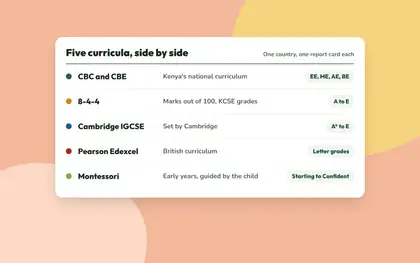
For the bigger picture, our guides explain why CBC is now called CBE, how 8-4-4 grading differs for any Form classes you still teach, and how every curriculum fits together in curricula in Kenya explained.
FAQ
What should a CBC report card comment include?
What the learner can do, one piece of evidence from their work, and one clear next step. Two or three sentences per learning area is enough.
How do you write a comment for a learner at Below Expectations?
Start with a real strength, name the specific skill that needs work, say what the school will do, and suggest one simple thing the family can do at home. Speak to the parents before the report goes home.
What is a good comment for Meeting Expectations?
Confirm the learner has reached the expected standard, name what they can do, and give a next step towards Exceeding Expectations, for example: “Can solve two step word problems accurately. Next, practise explaining each step in writing.”
Should CBC comments be written in English or Kiswahili?
Usually in the language of the learning area or the language your school uses for reports. Kiswahili comments for the Kiswahili learning area are natural and many parents appreciate them.
What marks are Exceeding Expectations in CBC?
At the 2025 KJSEA release, Exceeding Expectations covered 75 to 100% (EE2 for 75 to 89%, EE1 for 90 to 100%). In classroom assessment the teacher judges the level against the task’s rubric. Our CBC grading system guide has the full table.
What are the seven CBC core competencies?
Communication and collaboration, self efficacy, critical thinking and problem solving, creativity and imagination, citizenship, digital literacy, and learning to learn, as set out in KICD’s Basic Education Curriculum Framework.
Sources
- Kenya National Examinations Council, Competency Based Assessment Framework, Age Based (Regular), sections 5.2.1 to 5.2.3 on the School Readiness Report, School Year Report and assessment sheet: knec.ac.ke
- Kenya Institute of Curriculum Development, Basic Education Curriculum Framework (core competencies and values): kicd.ac.ke
- The Star, “How candidates were graded in KJSEA”, 11 December 2025: the-star.co.ke