The 8-4-4 grading system awards each KCSE subject a letter grade from A to E, and each grade carries points from 12 (A) down to 1 (E). A candidate’s mean grade comes from the points in seven subjects: Mathematics, one language, and the five other subjects in which they did best.
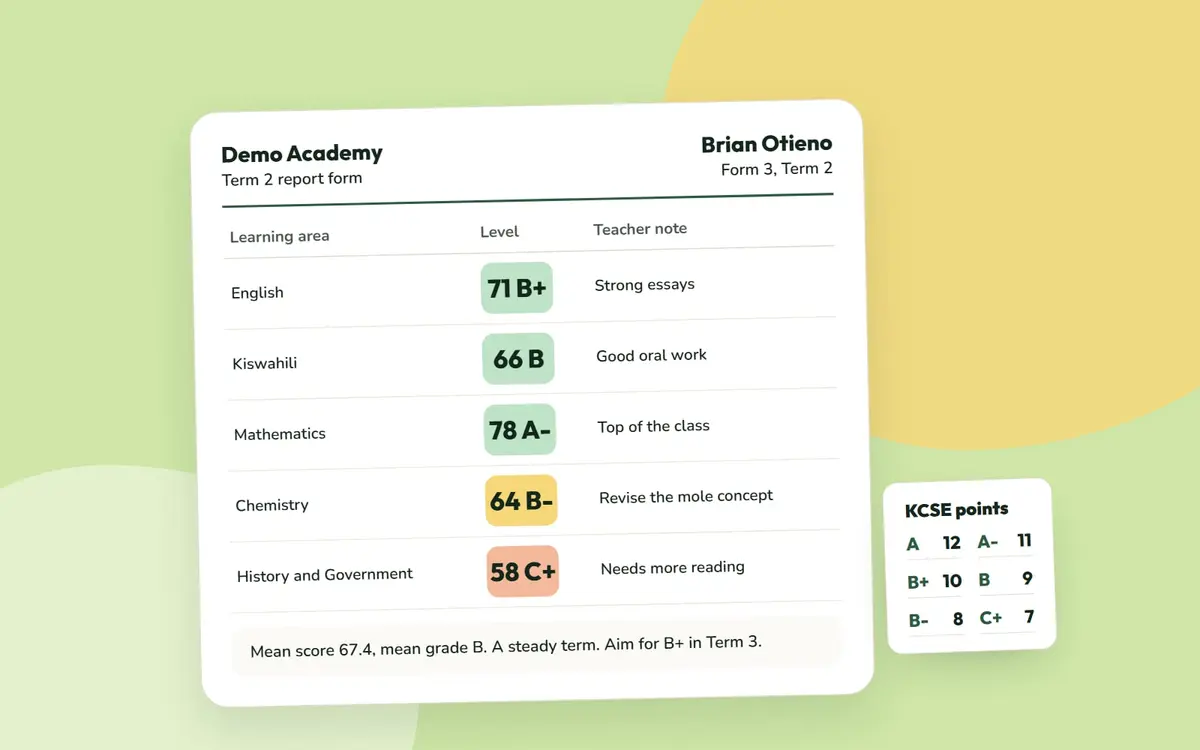
Quick answer: A = 12, A- = 11, B+ = 10, B = 9, B- = 8, C+ = 7, C = 6, C- = 5, D+ = 4, D = 3, D- = 2, E = 1. Add the points of the seven subjects that count, divide by seven, and read the result back onto the same scale to get the mean grade. C+ (7 points) is the mean grade that typically qualifies a candidate for a university degree place.
The KCSE grading system: grades and points
| Grade | Points |
|---|---|
| A | 12 |
| A- | 11 |
| B+ | 10 |
| B | 9 |
| B- | 8 |
| C+ | 7 |
| C | 6 |
| C- | 5 |
| D+ | 4 |
| D | 3 |
| D- | 2 |
| E | 1 |
This twelve step scale is what most Kenyans mean by “the 844 grading system”. It is used for KCSE, the national exam at the end of Form Four, and most secondary schools use the same scale for their internal exams, so that an end of term result can be compared with what a learner might expect in KCSE.
Which subjects count towards the mean grade?
KNEC’s KCSE user guide says every candidate, except repeaters, must sit a minimum of seven and a maximum of nine subjects. English, Kiswahili and Mathematics are compulsory to sit (candidates with hearing impairment may take Kenyan Sign Language in place of Kiswahili), with at least two sciences and one humanity in the usual combination.
Sitting a subject is not the same as it counting. From the 2023 KCSE, the Ministry of Education changed how the mean grade is computed; KNEC’s guide notes that entry requirements stayed the same and only the grading criteria changed:
- Mandatory for the mean grade: Mathematics and one language subject.
- The rest: the five other subjects in which the candidate performed best.
That gives seven subjects in total. Before 2023, five subjects drawn from set clusters were mandatory for the mean grade, so a learner’s best subject could be left out if it fell outside those clusters. The change, announced in September 2023 by then Education Cabinet Secretary Ezekiel Machogu, means a learner who is strong in, say, Agriculture and Business Studies is no longer held back by a weak second science.
Taking eight or nine subjects therefore still makes sense. It gives the candidate more subjects to choose the best five from.
KCSE subject groups
KNEC sorts KCSE subjects into five groups. The table below summarises the KNEC user guide; it is not the full list of codes.
| Group | Examples | Rule for sitting |
|---|---|---|
| Group I | English, Kiswahili, Mathematics | All compulsory |
| Group II | Biology, Physics, Chemistry, General Science | At least two sciences in the usual combination |
| Group III | History and Government, Geography, CRE, IRE or HRE | At least one |
| Group IV | Home Science, Art and Design, Agriculture, Computer Studies and technical subjects | Optional |
| Group V | French, German, Arabic, Kenyan Sign Language, Music, Business Studies | Optional |
How to calculate a KCSE mean grade
Step 1: Convert each subject grade to points
Use the table above. A B+ in Mathematics is 10 points; a C in English is 6.
Step 2: Pick the seven subjects that count
Mathematics, the better of the languages that qualify, and the best five of the rest.
Step 3: Add up the points
The total is the candidate’s aggregate. The highest possible is 84 (seven subjects at 12 points each); the lowest is 7.
Step 4: Divide by seven and read the grade
Divide the total by seven to get the mean points, then find the grade with those points.
Worked example. A Form Four learner gets:
| Subject | Grade | Points |
|---|---|---|
| Mathematics | B | 9 |
| English | C+ | 7 |
| Kiswahili | B- | 8 |
| Biology | B+ | 10 |
| Chemistry | C | 6 |
| History | B | 9 |
| Business Studies | A- | 11 |
| Agriculture | B+ | 10 |
Mathematics counts (9). The better language is Kiswahili (8). The best five of the remaining six are Business Studies (11), Biology (10), Agriculture (10), History (9) and English (7), leaving Chemistry out.
Total: 9 + 8 + 11 + 10 + 10 + 9 + 7 = 64. Mean: 64 divided by 7 = 9.14, which sits at B.
When the mean falls between two grades, schools apply a rounding rule to their own internal results. KNEC’s official cut offs decide national results, and KNEC’s user guide does not publish them, so treat an internal mean grade as a guide to KCSE, not a guarantee. Be wary of guides that compute the mean from eight subjects: the rule since 2023 is seven.
KCSE special grades: X, Y and W
Besides A to E, a result slip can carry a letter that is not a grade at all:
| Letter | Meaning |
|---|---|
| X | The candidate was absent from the examination |
| Y | The result is linked to an examination irregularity |
| W | The result is withheld |
KNEC communicates pending, withheld and irregular results to the school through the Sub County Director of Education when results are released.
From mean grade to university: cluster points
The mean grade is not the whole story for university. KUCCPS, which places government sponsored candidates in universities and colleges, uses weighted cluster points: a candidate’s performance in the four subjects a degree programme requires, weighed against the best candidates in that KCSE year. A programme’s cut off is the weighted cluster points of the last candidate placed in it. KUCCPS says the seven best performed subjects feed the calculation, and it advises candidates not to compute cluster points themselves, because some inputs come only from KNEC; the computed points appear on the KUCCPS portal. Applicants can choose up to six degree courses.
How are marks turned into grades?
Points start from a grade, and the grade starts from a mark. In a school’s internal exam, each subject’s percentage is converted to a letter grade using a grading scale, which the school or the department sets. Scales differ between schools and between subjects, because a 60% in a hard Mathematics paper and a 60% in an easier paper do not mean the same thing.
Press guides circulate different “standard” percentage bands for KCSE grades, and they do not agree with each other. We have not printed one for that reason. For your school’s internal exams, the right scale is the one your academic department has agreed and applies consistently.
Ranking learners under 8-4-4
Schools use the same points to build merit lists:
- By total points or mean points across the counted subjects.
- By mean grade within a class or stream, to compare learners.
- By subject mean, to see how each subject performed against last term or last year.
These reports are useful for teachers and the board, but they are also where most spreadsheet errors creep in: a formula copied down one row too few, a subject wrongly left in the count, a learner missing from the list.
8-4-4 alongside CBC/CBE
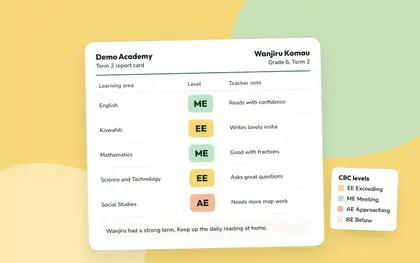
8-4-4 is being phased out as CBC/CBE learners move up into senior school, and the two grading systems are very different. CBC/CBE uses performance levels (EE, ME, AE, BE) and, at KJSEA, KNEC’s eight point scale with no mean grade. During the transition, many schools run both: 8-4-4 in the remaining Form classes and CBC/CBE in the grades. Our guide to the CBC grading system in Kenya explains that side, CBC is now CBE explains the change of name, and senior school pathways under CBE covers what replaces Form One to Four. For the full picture, including Cambridge and Pearson Edexcel, see curricula in Kenya explained.
How Enaton helps
Enaton runs 8-4-4 the way your school already does: subjects and their papers, marks entered once, grading and points by the rules your school sets, and mid term, end term, mocks and merged exams without rebuilding a spreadsheet each time. Merit lists and report cards come straight from the same marks. As your classes move to CBC/CBE, both curricula run side by side in one system, with fees, attendance and the parent portal included. See the 8-4-4 school management system and the school report card system, read what Enaton does for head teachers, or book a demo to see your own exams in it.
FAQ
How many points is an A in KCSE?
An A is worth 12 points, the highest on the scale. A- is 11 and B+ is 10.
How many subjects are used to calculate the KCSE mean grade?
Seven: Mathematics, one language subject, and the five other subjects in which the candidate performed best. This rule has applied since the 2023 KCSE. Candidates sit between seven and nine subjects.
What is the maximum KCSE aggregate?
84 points, from seven subjects at 12 points each.
What mean grade do you need for university?
A C+ (7 points) mean grade typically qualifies a candidate for university placement. Each degree programme then sets its own subject requirements, and competitive programmes are filled by weighted cluster points, so meeting the minimum does not guarantee a place. KUCCPS lists each programme’s requirements on its online portal.
What grade is 50 points in KCSE?
Divide by seven: 50 divided by 7 is about 7.1 mean points, which sits around C+ on the 12 point scale. KNEC’s own cut offs decide the official mean grade, so treat this as an estimate.
What does X mean in KCSE results?
X means the candidate was absent from the examination. Y signals an examination irregularity and W means the result is withheld.
Is the 844 grading system the same as CBC grading?
No. 8-4-4 uses letter grades from A to E with points from 12 to 1 and a mean grade. CBC/CBE uses performance levels (EE, ME, AE, BE), and KNEC does not issue an aggregate or mean grade at KJSEA.
Sources
- Kenya National Examinations Council, User Guide for the KCSE Examination, 2024 edition, section 2.8 on subject entry requirements: knec.ac.ke
- KUCCPS, Frequently Asked Questions (cluster points, cut off points, subjects considered, number of choices): kuccps.net
- Kenyans.co.ke, explainer on how KNEC grades KCSE by subject combination, 8 January 2026: kenyans.co.ke
- Citizen Digital, “New KCSE grading structure to take effect this year; here is how it will work”, 25 September 2023: citizen.digital
- The Star, “2023 KCSE examination: the new grading system”, 26 September 2023: the-star.co.ke
- The Star, “KNEC explains new KJSEA grading system”, 15 December 2025: the-star.co.ke