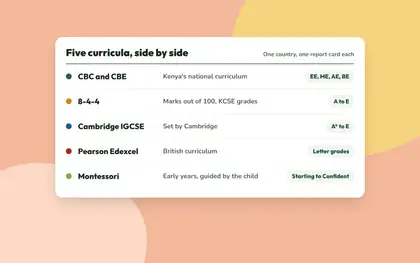
Cambridge IGCSE is an international qualification for learners aged about 14 to 16, set and marked by Cambridge International, part of the University of Cambridge. In Kenya it is offered by private and international schools that are registered Cambridge schools, usually as a two year course followed by AS and A level.
Quick answer: Cambridge IGCSE offers more than 70 subjects and is graded A* to G around the world (Cambridge offers a 9 to 1 scale only in its administrative zone 3, so ask your school which scale it enters). Exams run in two main series, June and November. June results come out in August (18 August in 2026) and November results in January (14 January 2027 for IGCSE and 7 January 2027 for AS and A level, for the November 2026 series). After IGCSE most learners take AS and A level, and a Kenyan university or college admits IGCSE and A level holders once KNEC has equated the certificates.
What is IGCSE, and what does IGCSE stand for?
IGCSE stands for International General Certificate of Secondary Education. Cambridge describes it as the world’s most popular international qualification for 14 to 16 year olds, and says leading universities and employers worldwide accept it as evidence of academic ability. It was first examined in June 1988.
It sits at the same stage as the GCSE that learners take in England, and Cambridge aligns the standards of the two. Pearson Edexcel offers a similar qualification called the International GCSE; we compare the two in our guide to Pearson Edexcel and the British curriculum. For every curriculum taught in Kenya side by side, start with our guide to the curricula in Kenya.
How does the Cambridge curriculum work in Kenyan schools?
Cambridge calls its full route the Cambridge Pathway. Schools in Kenya usually run several of its stages:
| Stage | Typical ages | What happens |
|---|---|---|
| Cambridge Primary | 5 to 11 | Foundation in English, Mathematics, Science and other subjects, with optional Cambridge tests |
| Cambridge Lower Secondary | 11 to 14 | Broader subjects, preparing for IGCSE, with optional Cambridge tests |
| Cambridge IGCSE | 14 to 16 | Usually a two year course in chosen subjects, ending in Cambridge exams |
| Cambridge International AS and A level | 16 to 19 | AS is typically one year, the full A level typically two |
Classes are usually called Year groups rather than Grades. Some schools in Kenya run Cambridge alongside CBC/CBE, so a learner may follow the national curriculum in the early years and join the Cambridge track later. See moving from CBC to IGCSE for the usual entry points.
IGCSE subjects in Kenya
Cambridge offers more than 70 IGCSE subjects, including 30 languages, and schools can offer them in any combination. Each school chooses which it can teach well, so the list at one school will be shorter. Common choices include English, Mathematics, the sciences (Biology, Chemistry, Physics), Geography, History, Business Studies, Economics, Computer Science and foreign languages.
When choosing, keep the next step in mind:
- For a Kenyan university: KNEC’s current guidelines say that to equate a certificate to KCSE, the learner must have taken at least seven subjects, including Mathematics and a language. Keep English and Mathematics, and add the subjects your child’s likely degree asks for.
- For UK universities: Cambridge says most UK universities do not set specific grade requirements at IGCSE, apart from a grade C or above in English Language, Mathematics and, in some cases, Sciences.
How is IGCSE assessed? Core and Extended
Assessment takes place at the end of the course. Depending on the subject it can include written papers, oral tests, coursework and practical work.
In many subjects there is a choice between a Core and an Extended curriculum, to suit a wide range of abilities. Ask which one your child is entered for in each subject.
IGCSE grading system: A* to G
Cambridge says its IGCSEs are graded A to G* around the world, using eight grades. A* is the highest grade and G the lowest.
There is also a 9 to 1 scale, where 9 is highest. Cambridge offers 9 to 1 graded IGCSEs only in its administrative zone 3, where schools can choose either scale, and all schools can keep A* to G. A* to G is the scale Cambridge uses around the world, but ask your school which one it enters. Do not confuse this with Pearson Edexcel International GCSE, which is graded 9 to 1.
How do the two scales line up? Cambridge says the standards at the thresholds of grades 7, 4 and 1 are the same as at the thresholds of A, C and G. Grade 9 marks out the very top performers.
IGCSE grade boundaries 2026
Grade boundaries are the marks needed for each grade. Cambridge calls them grade thresholds and sets them after each exam has been marked, so that each grade is no harder and no easier to get than the year before. They change from series to series and are published after each series, per syllabus. There is no fixed percentage for an A* or a C.
If you are looking for the “IGCSE grade boundaries 2026”, use Cambridge’s grade threshold tables for the right series (June or November 2026) and syllabus code. Pages that publish boundaries before results day are guessing.
When are IGCSE results coming out?
Cambridge exams run in two main series each year:
- June series: results in August. For June 2026, Cambridge released AS and A level results on 11 August 2026 and IGCSE results on 18 August 2026.
- November series: results in January. For November 2026, Cambridge gives 7 January 2027 for AS and A level and 14 January 2027 for IGCSE.
How do I check my Cambridge IGCSE results?
Results go to the school first. You may collect them at school, or the school may give you a password for Cambridge’s secure results website; lost login details come from the school’s exams officer. If you think a grade is wrong, the school can ask Cambridge for an enquiry about results. If a university abroad needs results quickly, Cambridge’s priority results service sends a provisional statement to it on results day.
IGCSE schools in Kenya: how to check a school
Lists of “IGCSE schools in Kenya” go out of date quickly. Use Cambridge’s own “Find a Cambridge school” search, which lists Cambridge schools by country with their address and website. Then ask the school which board’s exams your child will sit in each subject (some use Cambridge and Pearson Edexcel) and how it runs the years before IGCSE.
Can I sit IGCSE as a private candidate in Kenya?
Yes, through a school that accepts private candidates or a Cambridge approved exam centre, which runs Cambridge exams but does not teach.
AS and A level after IGCSE
After IGCSE, most learners in Cambridge schools continue to Cambridge International AS and A levels. Cambridge offers 55 subjects, and many learners take three or four. A level is typically two years and AS one, covering half the A level content. In many subjects a learner can sit AS first and finish the full A level in a later series. A level is graded A* to E; AS has no A* and runs from A to E. Exams are in June and November, with results in August and January.
Can you join a Kenyan university with IGCSE?
Yes. KNEC equates school certificates from foreign exam boards. Its guidelines of April 2025 set out the main conditions:
- To equate a certificate to KCSE, the learner must have taken at least seven subjects, including Mathematics, a language and any five others.
- To equate an A level certificate, the learner must also send the matching O level (IGCSE) certificate, and must have at least a Division II at O level or a KCSE mean grade of C (plain).
- The exam board must confirm the results directly to KNEC before processing starts.
- Applications are made online through KNEC’s QMIS platform and paid by M-Pesa. KNEC charged KES 3,480 per equation letter in those guidelines and said processing takes ten working days. The letter is sent to the institution that asked for it, not to the parent.
KNEC also warns that its rules may change without notice, so check the current guidelines before your child chooses subjects.
Universities then apply their own entry rules. The University of Nairobi, for example, lists IGCSE and GCE among the international qualifications it treats as equivalent to KCSE for bachelor’s degree entry. Each course sets its own grades, and some need A level. Check with the university early.
How Enaton helps
Enaton runs Cambridge the way Cambridge works: Year groups, subjects chosen per learner rather than fixed per class, A* to G grading, AS and A level as their own year groups, and Cambridge format report cards parents can read. A dual curriculum school runs Cambridge beside CBC/CBE in one system, with one register, one fee account and one parent login per family; see one system for several curricula. Head teachers can see how Enaton supports the whole school, and parents can see what Enaton gives families. See the Cambridge school management system, or book a demo. Want this at your child’s school? Share this guide with the head teacher, or tell them about Enaton.
Still choosing a curriculum? Read which curriculum is best for my child.
Frequently asked questions
What is IGCSE in Kenya?
The Cambridge International General Certificate of Secondary Education, an international qualification for learners aged about 14 to 16, taught by private and international schools that are registered Cambridge schools.
Is IGCSE graded A* to G or 9 to 1?
Cambridge IGCSE is graded A* to G around the world. Cambridge offers 9 to 1 only in its administrative zone 3, so ask your school which one it enters. Pearson Edexcel International GCSE, a different qualification, is graded 9 to 1.
When are IGCSE results coming out?
June series results come out in August (18 August in 2026). November series results come out in January (14 January 2027 for IGCSE and 7 January 2027 for AS and A level, for November 2026). Your school releases them to you.
Where can I find IGCSE grade boundaries?
On the Cambridge International website, as grade threshold tables for each syllabus and series, published after each series. Boundaries change every series.
Is IGCSE recognised in Kenya?
Yes. KNEC equates IGCSE certificates that meet its rules, including at least seven subjects with Mathematics and a language, and universities such as the University of Nairobi list IGCSE among the qualifications they accept, with their own entry grades.
Sources
- Cambridge International, Cambridge IGCSE: cambridgeinternational.org
- Cambridge International, Cambridge IGCSE curriculum (over 70 subjects, 30 languages): cambridgeinternational.org
- Cambridge International, Cambridge IGCSE qualification (first examined 1988, Core and Extended, A* to G, June and November): cambridgeinternational.org
- Cambridge International, Cambridge IGCSE grading choice: cambridgeinternational.org
- Cambridge International, Support for A* to G grading (university entry at IGCSE): cambridgeinternational.org
- Cambridge International, How 9 to 1 grading will work (grades 7, 4 and 1 against A, C and G): cambridgeinternational.org
- Cambridge International, Cambridge IGCSE grade threshold tables: cambridgeinternational.org
- Cambridge International, Cambridge Primary and Cambridge Lower Secondary: Primary, Lower Secondary
- Cambridge International, Cambridge International AS and A Levels: cambridgeinternational.org
- Cambridge International, AS and A Level qualification (length, staged route, grading): cambridgeinternational.org
- Cambridge International, “Exam Results information”, June 2026 series dates (archived 29 June 2026): web.archive.org
- Cambridge International help centre, “When will November 2026 results be released?”: help.cambridgeinternational.org
- Cambridge International, “Exam Results information” (November 2026 dates, how results are released, enquiries, priority service): cambridgeinternational.org
- Cambridge International, Find a Cambridge school: cambridgeinternational.org
- Kenya National Examinations Council, “Guidelines on Equation of Foreign Certificates”, 2 April 2025 (archived copy): web.archive.org
- University of Nairobi, “Procedure for Equation of Foreign Qualifications” (admission criteria): uonbi.ac.ke