No curriculum is best for every child. The best curriculum for your child is the one that fits how they learn, leads where your family wants them to go, and that you can keep them in until they finish, at a school that teaches it well.
Quick answer: Start with three questions. Where is your child likely to go to university, in Kenya or abroad? How does your child learn best? Can you afford the same curriculum, at a good school, all the way to the end? The answers usually narrow the choice to one or two options, and then the school matters more than the curriculum.
This guide is for parents comparing CBC/CBE, Cambridge, Pearson Edexcel or British, Montessori and other options. If you want a summary of each first, read curricula in Kenya explained.
Which curriculum is best in Kenya?
Parents often ask this as if one curriculum wins. It does not. Each was designed for a purpose:
- CBC/CBE is the national curriculum. It leads to senior school pathways and Kenyan universities, and every school in the country understands it. The Ministry of Education renamed CBC as Competency Based Education (CBE) in April 2025; our guide on CBC becoming CBE explains what changed.
- Cambridge and Pearson Edexcel lead to IGCSE and A level, qualifications recognised by universities around the world and used by many Kenyan families who plan to study abroad.
- Montessori is an approach for young children, not a route to a final exam.
- IB and American programmes suit some families who move between countries or aim for particular universities abroad.
A strong school in any of these will serve your child better than a weak school in the curriculum you thought was best.
The curricula in Kenya at a glance
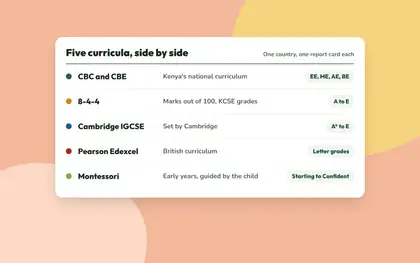
| CBC/CBE | Cambridge | Pearson Edexcel | Montessori | IB | |
|---|---|---|---|---|---|
| Who sets it | KICD (curriculum), KNEC (national assessments) | Cambridge International | Pearson | AMI and other Montessori bodies | International Baccalaureate |
| Ages | Pre-primary to Grade 12 | IGCSE for ages 14 to 16, then AS and A level | Qualifications for ages 5 to 19, including International GCSE and International A level | Mainly 3 to 6 in Kenya | Four programmes for ages 3 to 19 |
| Main exams | KJSEA at the end of Grade 9, then senior school | IGCSE, then AS and A level | International GCSE, then International AS and A level | None | IB Diploma at the end |
| Grades | Performance levels from EE1 (highest) to BE2 | IGCSE A* to G, A level A* to E | International GCSE 9 to 1, International A level A* to E | Teacher’s observation records | Set by the IB |
| Where it leads | Kenyan senior school pathways and universities | Universities in Kenya and abroad | Universities in Kenya and abroad | Grade 1 or Year 1 elsewhere | Universities in Kenya and abroad |
The table cannot tell you how well a school teaches, or how your child will feel there. Visit before you decide.
Question 1: Where might your child go after school?
This is the question that matters most, and it is fine not to know yet.
- Mainly Kenyan universities and colleges: CBC/CBE is the direct route. Junior school ends with KJSEA, senior school placement follows, and from Grade 10 learners follow a pathway such as STEM. Our guide to senior school pathways explains the choices.
- Universities abroad, or not sure: IGCSE and A level keep more doors open internationally. Kenyan universities also admit learners with these qualifications, after KNEC equates them.
- A specific country: check what that country’s universities ask for before you choose. Some prefer A level, some an American diploma, some the IB Diploma.
If you are unsure, choose the curriculum that keeps the most realistic options open for your family, not the one with the most prestige.
Can my child join a Kenyan university with IGCSE or A level?
Yes, but plan for it. The Kenya National Examinations Council (KNEC) equates foreign school certificates to Kenyan ones, and the University of Nairobi’s published procedure lists IGCSE, GCE and the International Baccalaureate among international qualifications accepted as equivalent to KCSE for degree entry. KNEC’s own guidelines of April 2025 say that for a certificate to be equated to KCSE, the learner needs at least seven subjects, including Mathematics, a language and any five others.
What this means for you: if your child is on IGCSE and may study in Kenya, make sure their subject choices include those areas. Rules change, so confirm the current requirements with KNEC and the university before your child chooses subjects.
Question 2: How does your child learn?
Watch your child for a few weeks and notice:
- Do they enjoy hands on projects, group work and showing what they can do? CBC/CBE asks for a lot of this, and so does Montessori in the early years. Read Montessori in Kenya if your child is still young.
- Do they like clear exams and steady practice towards them? IGCSE and A level are built around final examinations.
- Do they need to move at their own pace? Montessori classrooms are designed for this.
- Do they have a strong interest already, in sciences, arts or sport? CBC/CBE senior school pathways let them specialise from Grade 10, and A level lets them focus on a few subjects.
No child fits one box. Use this to rule things out, not to label your child.
Question 3: Can you keep your child in it to the end?
Continuity matters more than most parents expect. Moving a child between curricula, especially in the last years before a major exam, is hard on them.
Before you choose, ask yourself:
- Can we afford this school’s fees, uniforms, trips and exam entries every year until the final class, not only the first year?
- Are there good schools offering this curriculum near us at secondary level, not only at primary?
- If we move towns, or our income changes, what would we do?
International exams are taken at schools registered as centres with the exam board, and carry their own entry fees. Ask each school for its full fee structure, including exam fees, in writing. We do not publish fee figures here, because they vary by school and change every year.
CBC vs IGCSE: which is better?
Neither is better in general. They answer different questions:
- CBC/CBE is built around competencies and continuous assessment, with KNEC assessments along the way. It is the national curriculum, and it leads straight into Kenyan senior school placement.
- Cambridge IGCSE is built around subject syllabuses and final exams, taken at about 14 to 16. It leads to AS and A level and is widely used for universities abroad.
If you are weighing a change from one to the other, our guide on moving from CBC to IGCSE covers the entry points, and Cambridge IGCSE in Kenya and Pearson Edexcel and the British curriculum explain the two main international routes.
Should I move my child to another curriculum?
Many parents search “should I move my child to another school”, and the honest answer is: only for a clear reason. Good reasons include a real change in university plans, a move to another country, a school that is clearly not working for your child, or a child who is unhappy for reasons the school cannot fix.
Weaker reasons include what other parents are doing, or a school’s marketing. If you do move, the easiest points are at the natural breaks: the start of a level, or before the IGCSE years begin.
What to ask when you visit a school
Visit at least two schools, on a normal school day if you can. Ask:
- Which curriculum, exactly? “International” does not tell you. Ask for the curriculum by name and the exams your child will sit.
- Is the school a registered exam centre? For Cambridge or Pearson, ask for the centre number. For IB, ask whether the school is an authorised IB World School.
- Who teaches it? Ask how many teachers are trained in the curriculum they teach.
- How will you report my child’s progress? Ask to see a sample report card and how often parents get one.
- How do you communicate with parents? Ask how you will hear about results, attendance and fees during the term.
- What happens after the last class here? Ask where learners usually go next, and how the school helps with that move.
- Can my child sit in a class? Many schools offer a trial day.
Signs the school is right, whatever the curriculum
- Teachers can explain the curriculum in plain words.
- Classrooms are busy with work, not only decoration.
- The school answers your questions directly, including about fees.
- Reports tell you something specific about a child, not only a mark.
- Parents you speak to know how their children are doing.
How Enaton helps
Whatever curriculum you choose, ask the school how it will keep you informed. In schools that run on Enaton, the school runs CBC/CBE, 8-4-4, Cambridge, Pearson Edexcel and British, or Montessori classes on their own terms in one system, and parents see results, report cards, attendance, the school bus and fee receipts for every child in one parent portal account, even when siblings are in different curricula. See what Enaton gives parents, or, if you lead a school, book a demo. Want this at your child’s school? Share this guide with the head teacher, or tell them about Enaton.
Frequently asked questions
Which curriculum is best for my child?
The one that fits how your child learns, leads where your family wants them to go, and that you can keep them in to the end, at a school that teaches it well. No curriculum is best for every child.
Is CBC better than IGCSE?
Neither is better in general. CBC/CBE is the direct route to Kenyan senior school and universities. IGCSE leads to A level and is widely used for universities abroad. Kenyan universities also admit learners with international qualifications once KNEC has equated them.
Can my child go to a Kenyan university with IGCSE?
Yes, once KNEC has equated the certificates. To be equated to KCSE, a learner needs at least seven subjects, including Mathematics, a language and any five others, according to KNEC’s April 2025 guidelines. Confirm current rules with KNEC and the university.
Is it bad to change curriculum?
Not always, but it is easiest at natural breaks, such as the start of a level, and hardest just before a major exam. Move for a clear reason, not because others are moving.
Does an international curriculum guarantee a university abroad?
No. Universities look at grades, subjects and their own entry rules. The curriculum is one part of the picture.
Is Montessori a full curriculum?
Montessori is an approach mainly used for young children. Most Montessori children in Kenya later continue in CBC/CBE or an international curriculum, so ask the school what comes next.
Sources
- Kenyans.co.ke, “Ministry of Education Changes CBC to CBE”, 25 April 2025: kenyans.co.ke
- The Star, “KNEC explains new KJSEA grading system”, 15 December 2025: the-star.co.ke
- Cambridge International, Cambridge IGCSE (ages 14 to 16): cambridgeinternational.org
- Cambridge International, Cambridge IGCSE grading choice (A* to G): cambridgeinternational.org
- Cambridge International, AS and A Level qualification (A* to E): cambridgeinternational.org
- Pearson, Edexcel International GCSEs (ages 5 to 19 family, 9 to 1 grading): qualifications.pearson.com
- Pearson, International A level guidance for universities (A* to E): qualifications.pearson.com
- International Baccalaureate, Programmes (ages 3 to 19, IB World Schools): ibo.org
- Kenya National Examinations Council, “Guidelines on Equation of Foreign Certificates”, 2 April 2025 (archived copy): web.archive.org
- University of Nairobi, “Procedure for Equation of Foreign Qualifications” (qualifications accepted as equivalent to KCSE): uonbi.ac.ke
- AMI USA, Standards for AMI Montessori classrooms: amiusa.org