Montessori is a way of teaching young children in which they learn by doing: they choose work from carefully prepared materials, in a mixed age class, and move at their own pace with a trained teacher guiding them. In Kenya it is used mostly for children aged about 3 to 6, before or alongside CBC/CBE pre-primary.
Quick answer: Montessori was developed by the Italian physician and educator Maria Montessori, who opened her first Children’s House in Rome in 1907. A Montessori class mixes ages, uses hands on materials for practical life, the senses, language and mathematics, and gives children a long, uninterrupted work period: three hours every morning in classrooms that follow the standards of the Association Montessori Internationale (AMI). Montessori is an approach, not an exam system, so ask any Montessori school what your child moves on to after it.
What is Montessori? The meaning in simple words
“Montessori” refers to an approach to education named after Maria Montessori. In 1907 she opened the Casa dei Bambini, Italian for “Children’s House”, in a poor district of Rome. Her idea was that children learn best when they can choose purposeful work in an environment prepared for them, rather than sitting while an adult talks.
Three ideas sit at the centre:
- The prepared environment. The classroom is set up so that a child can reach, use and put back everything without help.
- The child chooses. Within limits, children choose what to work on and for how long.
- The teacher guides. The teacher, often called a guide, watches each child closely and introduces new work when they are ready.
What ages does Montessori cover?
AMI, the organisation Maria Montessori founded, sets out these levels in its classroom standards (ages are approximate):
| Level | Ages | Children per class (AMI standard) |
|---|---|---|
| Nido | about 2 months to 12 or 15 months | 1 to about 10 |
| Infant Community | 12 or 15 months to about 2.5 or 3 years | 10 to 14 |
| Primary (Children’s House) | about 2.5 or 3 to 6 | 24 to 35 |
| Elementary | 6 to 12 (or 6 to 9 and 9 to 12) | 24 to 35 |
In Kenya, most Montessori schools serve the Primary level, ages 3 to 6. Some offer a toddler class and a few run Montessori Elementary.
Parents are often surprised by the class sizes. AMI favours fairly large Primary classes, with one AMI trained teacher and one non teaching assistant, because a bigger mixed age group supports children’s social development. A small class is not automatically a better Montessori class.
What does a Montessori classroom look like?
If you visit, you will usually see:
- Children of different ages together. Older children help younger ones, and younger ones learn by watching.
- Low, open shelves with materials arranged by area, each with its own place.
- Children working alone or in small groups, on mats or at small tables, rather than in rows.
- A calm room. A busy Montessori class is quiet but not silent.
- One of each material. AMI’s standard is a complete set of materials with only one of each, so children learn to wait their turn.
Work is usually grouped in areas:
- Practical life: pouring, buttoning, sweeping, preparing food. These build focus, independence and fine motor control.
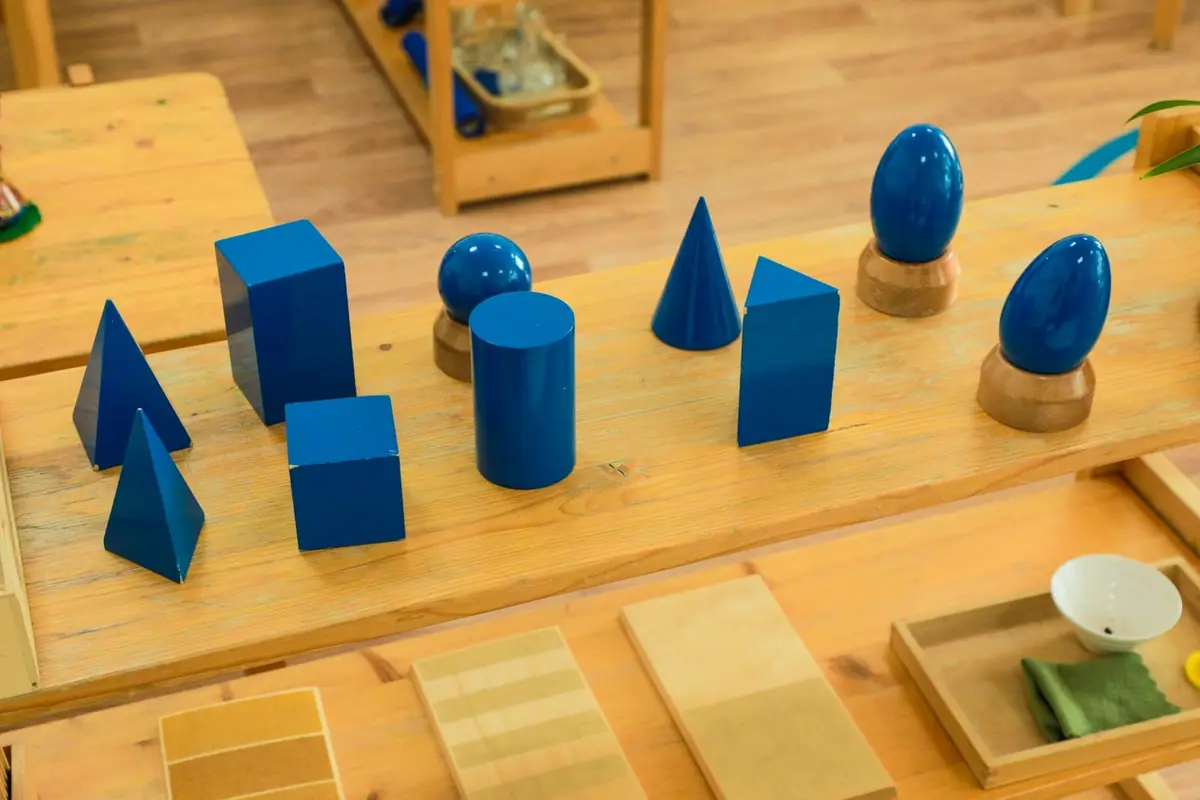
- Sensorial: materials that train the senses, such as cubes of different sizes, colour tablets and sound boxes.
- Language: spoken language, sandpaper letters, building words, then writing and reading.
- Mathematics: counting with beads and rods, then numbers, place value and early sums.
- Culture: geography, nature, art and music.
The Montessori day and the work period
AMI’s standard for the 3 to 6 class is a three hour uninterrupted work period five mornings a week, and two hour uninterrupted work periods five afternoons a week. “Uninterrupted” means no bells, no whole class lessons breaking in, and no children being pulled out for other activities. Many Kenyan schools run shorter days or add other lessons, so ask how the morning is actually organised.
Montessori and CBC/CBE pre-primary
In CBC/CBE, children spend two years in pre-primary (PP1 and PP2) before Grade 1. According to KICD’s chief executive, children are expected to join pre-primary at about age four and Grade 1 at about age six. Montessori’s 3 to 6 class covers the same years.
| Montessori 3 to 6 | CBC/CBE pre-primary | |
|---|---|---|
| Who sets it | AMI and other Montessori bodies set standards | KICD sets the curriculum |
| Class | Mixed ages, about 3 to 6 together | One year group per class (PP1, PP2) |
| How children learn | Child chooses from prepared materials | Learning activities set out by KICD |
| Time | Long uninterrupted work periods | Set by the school’s timetable |
| Leads to | No final exam; children move on to Grade 1 or Year 1 | Grade 1 in CBC/CBE |
The two share a lot: learning by doing, attention to each child, and building independence and communication, not only reading and counting.
Many families use Montessori for the early years and then move their child into Grade 1 in CBC/CBE, or into a Cambridge or British school. If that is your plan, ask the Montessori school:
- How it prepares children for Grade 1 or Year 1.
- Whether it also covers the CBC/CBE pre-primary learning areas.
- Which schools its children usually move on to.
For the wider picture, read curricula in Kenya explained, and for what follows the early years, which curriculum is best for my child.
Montessori vs a traditional preschool
| Montessori | Traditional preschool | |
|---|---|---|
| Who leads | The child chooses work; the teacher guides | The teacher leads activities for the whole class |
| Ages | Mixed, about 3 to 6 | Usually one age per class |
| Materials | Specific Montessori materials, one of each | Toys, books and worksheets |
| Pace | Each child at their own pace | The class moves together |
Neither suits every child. Some children thrive when they choose their own work; others settle better with a clear routine led by the teacher. Visit both kinds before you decide.
How to choose a Montessori school in Kenya
A school putting “Montessori” in its name does not tell you how closely it follows the method. Look for the real thing:
- Trained teachers. Ask where the lead teacher trained and whether the course was full Montessori teacher training, for example an AMI or AMS diploma, or another recognised programme.
- Mixed ages. A real Montessori Primary class has children of about 3 to 6 together, not one age per room.
- Long work periods. Ask how long children work without interruption in the morning. AMI’s standard is three hours.
- The materials. Shelves should hold complete sets of Montessori materials, in good condition, that children use themselves.
- Adults in the room. Ask how many children and adults are in each class, and who is trained.
- Registration. Ask the school to show you its registration certificate and who issued it.
- What comes next. Ask how children move on and how the school supports the change.
- The full fee structure. Ask for every charge in writing: tuition, meals, transport, trips and materials.
Visit during the morning work period and watch quietly for half an hour. It will tell you more than any brochure.
Where can I study Montessori in Kenya?
If you want to train as a Montessori teacher, start by deciding which qualification you want. AMI publishes its list of authorised training centres on its website. As of October 2026 that list shows no AMI training centre in Kenya; the nearest listed is the Montessori Training Centre of Dar es Salaam in Tanzania. AMI lists an affiliated society in Kenya, Montessori for Kenya. AMI says its diploma courses can be offered online or blended, but a large part is always done in person with AMI trainers.
Several colleges in Kenya also offer Montessori courses. Before you pay, ask which body awards the diploma, how much of the course is supervised practice in a real classroom, and whether schools you would like to work in accept it.
Records and parent communication
Montessori teachers do not usually give marks or grades. They keep observation records: notes on what each child chose, what they mastered, and what they are ready for next. A good Montessori school shares these with parents in a way you can read and act on.
Ask the school:
- How often will I get a progress report, and what will it say?
- What records will move with my child to their next school?
The records matter most at the move to Grade 1 or Year 1. A clear report helps the next teacher understand your child from the first day. Schools that run a Montessori section beside CBC/CBE or Cambridge classes face the same question at a larger scale; our guide to one school system for multiple curricula explains how they keep each child’s history in one place.
How Enaton helps
For Montessori schools and early years sections, Enaton keeps each child’s observation notes and progress reports on Montessori’s own terms, never forced into marks, and shares them with parents through the same parent portal used for fees, attendance and messages. Classes can hold children of different ages. When a child moves up into CBC/CBE, Cambridge or British classes, the history stays in the same system for the next teacher. See the Montessori school management system, what Enaton gives parents, or book a demo. Want this at your child’s school? Share this guide with the head teacher, or tell them about Enaton.
Frequently asked questions
What is the Montessori method?
An approach to teaching young children, developed by Maria Montessori, in which children choose work from prepared materials in a mixed age class and learn at their own pace with a trained teacher guiding them.
At what age should my child start Montessori?
Most Montessori schools in Kenya take children from about age 3, for the 3 to 6 class. AMI’s standards place the Primary class at about 2.5 or 3 to 6, and some schools also run a toddler class for younger children.
How many children are in a Montessori class?
AMI’s standard for a 3 to 6 class is 24 to 35 children, with one AMI trained teacher and one non teaching assistant. Many schools in Kenya run smaller classes; ask how many children and trained adults are in your child’s room.
Is Montessori recognised in Kenya?
Montessori is a teaching approach, not an exam system, so there is no Montessori certificate your child will sit for. What matters is that the school is properly registered and that your child can move on smoothly to Grade 1 or Year 1.
Can my child move from Montessori to CBC/CBE?
Yes. Many children move from a Montessori class into Grade 1. Ask the Montessori school how it prepares children for that move and whether it covers the CBC/CBE pre-primary learning areas.
How much are Montessori school fees in Kenya?
Fees vary widely between schools, and we do not publish figures we cannot check. Ask each school for its full fee structure in writing, including meals, transport and trips.
Sources
- AMI USA, Standards for AMI Montessori classrooms (ages, class sizes, teacher and assistant, materials, work periods): amiusa.org
- Association Montessori Internationale, What we do (founded by Maria Montessori): montessori-ami.org
- Association Montessori Internationale, Montessori 3 to 6: montessori-ami.org
- Association Montessori Internationale, Training centres: montessori-ami.org
- Association Montessori Internationale, Kenya: montessori-ami.org
- Association Montessori Internationale, FAQ (online and blended diploma courses): montessori-ami.org
- American Montessori Society, History of Montessori (Casa dei Bambini, Rome, 1907): amshq.org
- American Montessori Society, What is Montessori (Italian physician and educator): amshq.org
- People Daily, “Grade 9 won’t be moved, says KICD” (2-6-3-3 structure, pre-primary at age four): peopledaily.digital