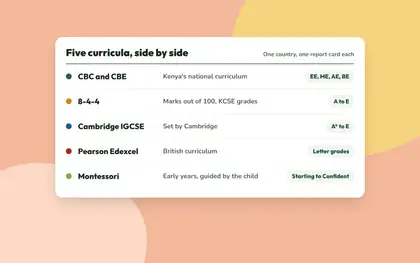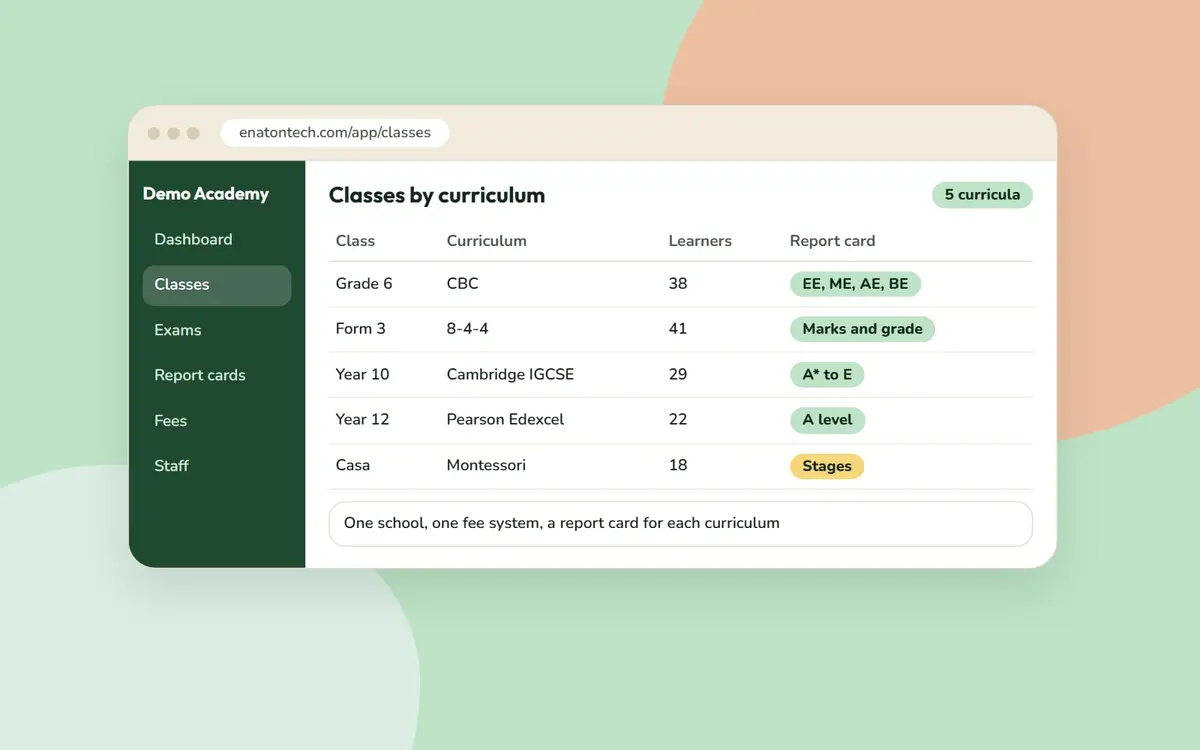
A school that runs more than one curriculum needs one school system that treats each curriculum on its own terms: CBC/CBE with learning areas and performance levels, Cambridge and Edexcel with year groups and letter or number grades, Montessori with observation records. Everything else, the learner register, fees, attendance and the parent account, should be shared.
Quick answer: The common mistake in a dual curriculum school is forcing every curriculum into one marks table, or running the international section on spreadsheets beside a local system. The better setup is one learner record per child with the right academic structure attached, report cards in each curriculum’s own format, one fee system and one parent login for every child in the family. Enaton runs CBC/CBE, 8-4-4, Cambridge, Pearson Edexcel and British, and Montessori this way in one system.
This guide is for school owners, directors and principals of dual curriculum and international schools in Kenya. If you want a plain summary of each curriculum first, read curricula in Kenya explained.
What is a dual curriculum school?
A dual curriculum school teaches two curricula side by side, usually the national CBC/CBE and an international one such as Cambridge or Pearson Edexcel. Some schools run them as separate tracks that families choose between; others teach parts of both to the same learners. Many add a Montessori early years section, so in practice a “dual” curriculum school often runs three.
Why multiple curricula are hard to run
Most Kenyan dual curriculum schools look something like this: Montessori or CBC/CBE pre-primary in the early years, CBC/CBE in one track, and Cambridge or Pearson Edexcel in another, sometimes with the last 8-4-4 Form classes still finishing.
Each curriculum records learning differently:
| Curriculum | How classes are named | How achievement is recorded |
|---|---|---|
| CBC/CBE | PP1, PP2, Grade 1 to Grade 12 | Learning areas, strands and sub strands; four performance levels (Exceeding, Meeting, Approaching and Below Expectations), which KNEC splits into eight, from EE1 to BE2, for KJSEA |
| 8-4-4 | Form 1 to Form 4 | Subjects and papers, KCSE grades A (12 points) to E (1 point) |
| Cambridge | Year groups | Subjects chosen per learner; IGCSE A* to G; A level A* to E, AS level A to E |
| Pearson Edexcel and British | Key stages and Year groups | International GCSE 9 to 1; International A level A* to E |
| Montessori | Mixed age classes | Observation notes and progress in each area of the classroom |
When a school system only understands one of these, the others end up on spreadsheets kept by whoever understands them. That works until that person leaves, or until a parent asks a question the spreadsheet cannot answer.
What a school system for multiple curricula must do
When you compare systems, check these points one by one.
Each curriculum keeps its own structure
CBC/CBE needs learning areas with strands and sub strands. Cambridge and Edexcel need Year groups and subjects chosen per learner, because two learners in the same year rarely take the same set. Montessori needs classes that hold children of different ages. A system that renames the columns of one marks table is not handling multiple curricula; it is hiding them.
Each curriculum keeps its own grading
EE1 to BE2 are not percentages. A* to G is not 9 to 1. The grading scale should be set per curriculum, so a Cambridge report shows Cambridge grades and a CBC/CBE report shows performance levels. Our guides to the CBC grading system and the 8-4-4 grading system explain the national scales in detail.
Report cards per curriculum
Parents of a Cambridge learner expect a different report from parents of a CBC/CBE learner. Ask to see a sample report for each of your curricula, built from the marks or observations teachers actually entered, not retyped at the end of term.
One timetable across tracks
Teachers are often shared between tracks, and labs, halls and buses are always shared. Two timetables built in separate tools will clash. The timetable should know every class in every curriculum, every teacher and every room.
One learner record, even when a learner changes track
Learners move: from Montessori to Grade 1, from CBC/CBE to the IGCSE track, sometimes back. The record should follow the learner, with their history in each curriculum kept, rather than starting a new file each time.
One fee system for every section
The bursar should bill every section from the same system, even when fee structures differ by curriculum. The director should see one set of figures for the whole school, not two to add together.
One parent account for every child
A family with one child in CBC/CBE and another in Cambridge should not need two logins. One parent account should show every child, with each child’s results in their own curriculum’s format.
Exam calendars to plan around
A dual curriculum school answers to more than one exam board. Put every series in one school calendar at the start of the year:
| Board | Exam | When it is sat |
|---|---|---|
| KNEC | KJSEA (end of Grade 9) | KNEC sets the dates each year |
| KNEC | KCSE (Form 4, 8-4-4) | KNEC sets the dates each year |
| Cambridge International | IGCSE, AS and A level | June series and November series |
| Pearson | International GCSE | May to June and November |
| Pearson | International AS and A level | January, May to June and October |
Each board also sets its own entry deadlines and fees. Keep both calendars in one place so no entry is missed. For results dates, see our guides to Cambridge IGCSE in Kenya and Pearson Edexcel and the British curriculum.
Running CBC/CBE alongside Cambridge or Edexcel
This is the most common pairing in Kenya. A few practical points for principals:
- Name the tracks clearly. Parents and staff should always know which track a class is on.
- Decide your transfer points. Agree when a learner can move from CBC/CBE to the IGCSE track, and what entry assessment applies. Families will ask what the new class, subjects and exams mean for their child, so put the answers in writing. Our guide on moving from CBC to IGCSE is written for those parents.
- Plan subject choices with Kenyan universities in mind. For a foreign certificate to be equated to KCSE, KNEC asks for at least seven subjects, including Mathematics, a language and any five others, according to its April 2025 guidelines. Confirm current rules with KNEC.
- Keep KEMIS records for every learner. Registration on KEMIS is mandatory for both public and private institutions. International track learners are still learners at a Kenyan school. Our guide to KEMIS explains what the Ministry expects.
Montessori in the early years
Many schools use Montessori for ages 3 to 6, then move children into Grade 1 or Year 1. The Montessori section should be able to record what guides observe, against the areas of the classroom, and give parents progress reports they can read, without converting a child’s work into marks. When the child moves up, the next teacher should be able to read that history. Our guide to Montessori in Kenya explains what a real Montessori class looks like.
How Enaton helps
Enaton supports five curricula in one system: CBC/CBE (CBC school management), 8-4-4, Cambridge (IGCSE, AS and A level, see Cambridge school management), Pearson Edexcel and British (key stages, International GCSE and A level, see British curriculum school management) and Montessori. Each keeps its own structure, grading and report card format, and every curriculum shares the same learner record, timetable, fees, attendance, transport, communication and parent portal, so parents sign in once and see every child. Learner records are kept KEMIS-ready.
Every module comes from the first day, from as low as KES 4,060 a month for a school. Running several campuses? Talk to Enaton: groups of schools are quoted, and every school gets every module. Moving from Excel, paper or another system, Enaton guides you through and brings your records across. See Enaton for head teachers and Enaton for school owners, or book a demo.
Questions to ask any vendor
- Show me a CBC/CBE report and a Cambridge or Edexcel report from the same school.
- How are subjects assigned to learners who each take a different set?
- Can a class hold children of different ages?
- Can one timetable cover every track, with shared teachers and rooms?
- What happens to a learner’s record when they move from one track to another?
- Can one parent see children in two different curricula with one login?
- How do you bring our existing records across?
Frequently asked questions
Can one system run CBC/CBE and Cambridge in the same school?
Yes, if it treats each on its own terms. Enaton keeps CBC/CBE learning areas and performance levels and Cambridge year groups, subjects and grades separate, while fees, attendance and the parent portal are shared.
Which curricula does Enaton support?
CBC/CBE, 8-4-4, Cambridge (IGCSE, AS and A level), Pearson Edexcel and British (key stages, International GCSE and A level) and Montessori, all in one system.
Can each curriculum have its own report card?
Yes. Report formats and grading are set per curriculum, so a Cambridge report does not have to look like a CBC/CBE one.
Do international track learners need to be on KEMIS?
Registration on KEMIS is mandatory for both public and private institutions in Kenya, so a private school’s learners are on it whatever curriculum they follow. If you are unsure how to record them, ask your local education office.
Do parents with children in different curricula need two accounts?
No. One parent account covers every child in the family, each shown in their own curriculum’s format.
Can we move our records from spreadsheets or another system?
Yes. Enaton guides the school through the move from Excel, paper or another school system and brings the records across.
Sources
- The Star, “KNEC explains new KJSEA grading system”, 15 December 2025: the-star.co.ke
- Kenyans.co.ke, how KNEC grades KCSE by subject combination (A = 12 to E = 1): kenyans.co.ke
- The Star, “Schools given until Friday to submit learner data for capitation”, 21 July 2026 (KEMIS mandatory for public and private): the-star.co.ke
- Cambridge International, Cambridge IGCSE grading choice: cambridgeinternational.org
- Cambridge International, AS and A Level qualification (A* to E, AS A to E): cambridgeinternational.org
- Cambridge International, Exam results information (November series): cambridgeinternational.org
- Cambridge International, Exam results information, June 2026 series (archived 29 June 2026): web.archive.org
- Pearson, Edexcel International GCSEs (May to June and November series): qualifications.pearson.com
- Pearson, Edexcel International AS and A Levels (January, May to June and October series): qualifications.pearson.com
- Pearson, International A level guidance for universities (A* to E): qualifications.pearson.com
- UK Government, The national curriculum (key stages and year groups): gov.uk
- Kenya National Examinations Council, “Guidelines on Equation of Foreign Certificates”, 2 April 2025 (archived copy): web.archive.org
- AMI USA, Standards for AMI Montessori classrooms: amiusa.org