KEMIS is the Kenya Education Management Information System, the Ministry of Education’s national digital register of learners, staff and institutions. It replaced NEMIS in January 2026, its official website is kemis.go.ke, and every school in Kenya, public or private, is expected to keep its learner records on it.
Quick answer: KEMIS in full is the Kenya Education Management Information System. It is run by the Ministry of Education, it was scheduled to go live on 9 January 2026 as the successor to NEMIS and was in use for capitation by July 2026, and it holds education data from early childhood to university. The official portal is at kemis.go.ke. Government capitation is processed using KEMIS data, so a school whose learners are missing or wrong on KEMIS risks losing funding for those learners.
To be clear: this guide is written by Enaton, a school management system. Enaton is not KEMIS, is not part of the government, and cannot log you into the KEMIS portal.
What is KEMIS in full?
KEMIS stands for Kenya Education Management Information System. The KEMIS website describes it as an integrated national platform for managing education data across institutions, learners, staff and supporting services, to help with planning, monitoring and service delivery. In plain terms: a central database, with tools to enter, check and report on who is learning where, who is teaching them, and which institutions exist.
What does KEMIS mean for schools?
In practice, KEMIS is where a school proves to the government which learners it actually has. According to The Star in July 2026, registration on KEMIS is mandatory for both public and private institutions, and government funding and capitation are processed through the platform. The Ministry was also using enrolment data on KEMIS to guide planning for primary and junior schools.
The KEMIS website’s own FAQ says KEMIS is mandatory for institutions, that non compliance may affect reporting, approvals and access to education services tied to the system, and that the Ministry may carry out compliance audits.
If a learner is not on KEMIS, or is recorded at the wrong school, the money and planning that follow that learner can go wrong too.
What did KEMIS replace? KEMIS vs NEMIS
KEMIS replaced NEMIS, the National Education Management Information System, which Kenyan schools used for years to register learners and obtain their Unique Personal Identifier (UPI).
| NEMIS | KEMIS | |
|---|---|---|
| Full name | National Education Management Information System | Kenya Education Management Information System |
| Scope | Mainly basic education | Early childhood through primary, secondary, TVET and university |
| Status | Replaced by KEMIS | Scheduled to go live on 9 January 2026, in use for capitation by July 2026 |
| Registration | Existing records | All schools register afresh |
| Links to other systems | Described by the Ministry as hard to integrate | Planned to connect basic education, higher education, TVET, KNEC and TSC |
Speaking before the launch, Basic Education Principal Secretary Prof Julius Bitok described NEMIS as rigid, limited in scope and not easily integrated with other government systems, as reported by Education News in January 2026. KEMIS was designed to follow a learner across every level of education. In the same report, Immigration and Citizen Services PS Belio Kipsang said each learner would be given a UPI from birth through civil registration.
Does NEMIS still work?
For school records, KEMIS is now the system. When KEMIS was unveiled in May 2025, Capital FM reported that all learners would be registered afresh on it, and the KEMIS FAQ confirms that all schools are required to register onto KEMIS afresh. Ask your County or Sub County Director of Education about anything you still need from old NEMIS records.
Where is the official KEMIS website?
The official KEMIS website is kemis.go.ke. The site lists the Ministry of Education, Jogoo House B, Nairobi, as its location. From the home page you can log in, onboard an institution, and read the FAQ.
People also search for “kemis.com”, “kemis.ac.ke” or “kemis.education.go.ke”. Those are not the address. Never type your school’s KEMIS credentials into a site you reached from a social media post, a video description or an unknown link. Type kemis.go.ke yourself.
KEMIS contact number and email
At the time of writing (October 2026), the KEMIS website lists:
- Phone: +254 20 3318581
- Email: helpdesk@kemis.go.ke (the FAQ’s address for password problems) and support@kemis.go.ke
- Address: Ministry of Education, Jogoo House B, P.O. Box 30040-00100, Nairobi
Contacts change, so check the KEMIS home page before you call. For questions about your school’s records or deadlines, your Sub County Director of Education is usually the fastest route.
KEMIS login: how do schools get access?
The KEMIS FAQ explains the steps:
- The institution registers (onboards) on KEMIS using its official details.
- Ministry of Education officials review and approve the registration.
- Login details are sent to the institution’s email given at registration, for authorised officers such as the head of institution and designated staff.
- Each user gets their own login. A school can have several users, such as the head, deputies, class teachers and accounts clerks, working at the same time, but two people cannot use one account at once.
- Forgot your password? Use the reset option on the KEMIS login page with your registered username (the institution’s email). If that fails, write to helpdesk@kemis.go.ke.
KEMIS works in modern browsers such as Chrome, Edge and Firefox. Access is by role, so each user only sees what their role allows.
How do you register learners on KEMIS?
Learner registration is done by the school once it is onboarded. Points from the official FAQ that trip schools up:
- The UPI is generated when a learner is registered or an existing record is updated.
- Use the birth certificate entry number, not the printed serial number on the certificate.
- Learners without an assessment number are registered using their KNEC index number, where they have one.
- When a learner changes school, the head of the institution edits the learner’s details.
- No reports are demanded at onboarding. Reports are generated from the data the school enters.
KEMIS is designed to stop non existent learners being added by using unique identifiers, and it keeps audit trails of user activity. The safest course is simply to record real learners accurately.
What do schools submit on KEMIS?
The detail is set by the Ministry and can change between circulars, so follow the latest instruction from your County or Sub County Director of Education. At a high level a school keeps its institution details, each learner’s details, grade and movement in and out of the school, and the enrolment figures that follow from them.
The Star reported in July 2026 that public secondary schools were given until Friday 24 July to submit learner enrolment data, and that the Ministry had received about 2.6 million learner records against an expected 3.2 million. That gap is the reason KEMIS deadlines matter: a learner not captured is a learner the system cannot count.
What else is on KEMIS? Modules and Grade 10 selection
The KEMIS home page lists modules for selection and placement, finance and capitation, quality assurance, staff management, institution management, learner management, and curriculum and academics. That is why “KEMIS school selection” is a common search: senior school selection and placement sit inside KEMIS. Our guide to senior school pathways under CBE explains pathways and placement, and CBC is now CBE explains the change of name.
Who uses KEMIS?
According to the KEMIS FAQ, KEMIS is used by institutions, learners, teachers, school administrators, quality assurance officers, county and national education officials, and other authorised stakeholders.
When KEMIS was unveiled in May 2025, Capital FM reported a planned parents’ app, the Elimu App. For now, a parent’s day to day view of fees, results and attendance comes from the school’s own parent portal.
Is there a KEMIS payment?
KEMIS is a records system, not a way to pay school fees. Its link to money runs the other way: government capitation is worked out using the learner numbers on KEMIS. Parents pay fees to the school’s own paybill or bank account, as the school instructs. See how to pay school fees using M-Pesa.
How to keep your school’s records KEMIS ready
Schools struggle with KEMIS when they only look at their learner records as a deadline arrives. A better habit:
- Record every learner fully at admission, including date of birth, birth certificate entry number, identifier and guardians, rather than “we will fill it in later”.
- Record exits properly. When a learner transfers, completes or leaves, change their status the same week. Deleting them from a list loses the history.
- Keep one register. If the bursar, the class teacher and the deputy each keep their own list, they will disagree. Pick one and make it the source.
- Check class lists every term against who is actually in the classroom. A well kept attendance register shows you quickly who has really left.
- Do not wait for the last day. Portals slow down when every school in the country logs in at once.
How Enaton helps
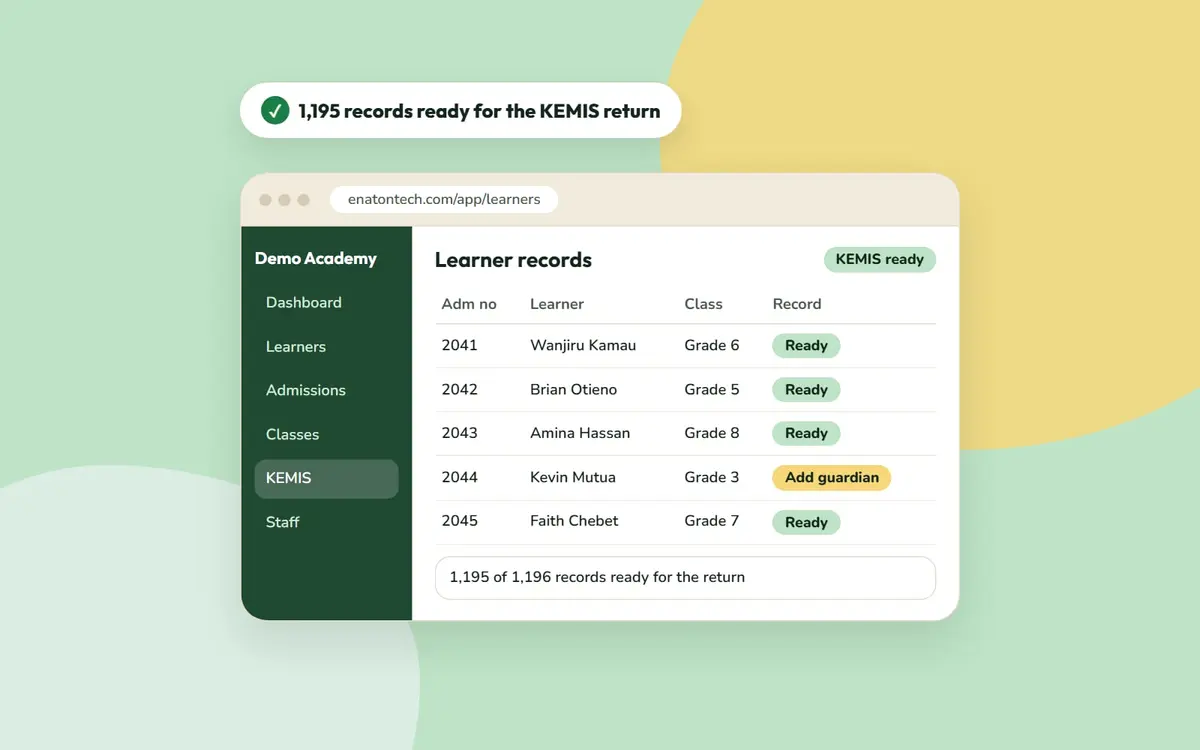
Enaton is a school management system, not KEMIS. It keeps your learner and staff records in the shape KEMIS expects as part of everyday work: full learner and guardian details at admission, classes and streams over time, and proper exit statuses when a learner leaves. Gaps show up during the term, not on the morning a return is due. When the Ministry asks for a return, you check and export what you already keep. See KEMIS ready learner records for schools, what Enaton does for head teachers, or book a demo to see it on your own class lists.
FAQ
What is KEMIS in full?
KEMIS stands for Kenya Education Management Information System. It is the Ministry of Education’s national system for learner, staff and institution records, and it replaced NEMIS in January 2026.
What is the official KEMIS portal?
The official KEMIS website is kemis.go.ke. Type the address yourself rather than following links from social media, and log in with the credentials sent to your institution’s email.
Is KEMIS the same as NEMIS?
No. KEMIS is the successor to NEMIS. It covers more of the education sector, from early childhood to university, and is designed to connect with other government systems. All schools register afresh on KEMIS.
Is KEMIS mandatory for private schools?
Yes. The Star reported in July 2026 that registration on KEMIS is mandatory for both public and private institutions, and the KEMIS FAQ says KEMIS is mandatory for institutions.
What is the KEMIS contact number?
The KEMIS website lists +254 20 3318581 and helpdesk@kemis.go.ke. Check the KEMIS home page for the latest contacts.
Can Enaton log me into KEMIS?
No. Enaton is a school management system and is not connected to your KEMIS account. Use the official portal and your institution’s credentials. Enaton helps by keeping the records you will need complete and current.
What happens if a learner is missing from KEMIS?
Capitation and planning are based on the learners recorded on KEMIS, so a missing learner may not be counted. Register them, and speak to your Sub County Director of Education about correcting records.
Sources
- KEMIS, official website and FAQ (Ministry of Education): kemis.go.ke
- The Star, “Schools given until Friday to submit learner data for capitation”, 21 July 2026: the-star.co.ke
- Education News, “Government to roll out KEMIS on January 9, 2026, to track learners nationwide”, 2 January 2026: educationnews.co.ke
- Capital FM, “New digital system to track learners, improve education data management”, 16 May 2025: capitalfm.africa