Yes, a child can move from CBC (now CBE) to IGCSE, and many Kenyan children do. The move is easiest before the two IGCSE years begin, usually around age 13 or 14, and the new school will normally place your child by age and an entry assessment rather than by their CBC grade alone.
Quick answer: Most Cambridge and Pearson schools in Kenya take CBC/CBE learners at almost any class up to the start of the IGCSE course, after an entry test in English and Mathematics. Moving in the middle of the IGCSE years is much harder. Moving back to CBC/CBE is possible too, but KNEC says anyone with foreign qualifications must get an equation from KNEC before joining an institution that offers KNEC exams, so plan before you move.
Can a child move from CBC to IGCSE?
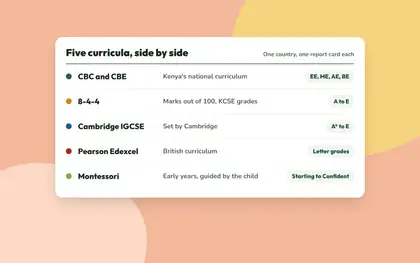
Yes. CBC/CBE and IGCSE are different systems, but they cover many of the same skills: reading, writing, Mathematics, sciences and languages. Schools that teach IGCSE are used to receiving learners from the national curriculum. For a side by side look at every curriculum in Kenya, see our guide to the curricula in Kenya.
What changes for your child:
- Class names. Cambridge and British schools usually use Year groups, so your child will be in “Year 8” rather than “Grade 7”, and the match depends on age and the school’s own policy.
- Grading. Instead of the CBC/CBE performance levels (explained in our CBC grading guide), your child will get letter or number grades. Cambridge IGCSE is usually graded A* to G. Pearson Edexcel International GCSE is graded 9 to 1.
- Subjects. IGCSE learners choose their own set of subjects for the final two years, from a long list.
- Exams. Cambridge IGCSE is assessed at the end of the course, through written papers and, in some subjects, oral, coursework and practical parts. Pearson offers linear or modular routes in many International GCSE subjects.
- The school year. The national school year starts in January. Some international schools run their year from September, so ask which term your child should join.
When is the best time to move?
Parents ask “can a child move from CBC to IGCSE in Grade 7?” or “in Grade 9?”. The short answer: the earlier, the easier. IGCSE is usually a two year course for ages about 14 to 16, taken in Year 10 and Year 11.
| When | How it usually goes |
|---|---|
| Lower and upper primary | Easiest. Schools place mainly by age and give time to settle. |
| Junior school (Grade 7 to Grade 8) | Still a good time. Learners join the years before IGCSE and catch up on the new style. |
| Just before the IGCSE course starts | The most common entry point. The learner starts the two year course with everyone else. |
| In the middle of the IGCSE course | Hard. Subjects, coursework and exam entries are already set. Many schools will not admit, or will ask the learner to repeat a year. |
| After KJSEA, before Grade 10 | Possible. Some families move here instead of taking up a senior school place. Ask the school how it places learners of this age. |
Every school sets its own rules, so ask before you decide. If you are weighing the senior school route instead, read our guide to senior school pathways under CBE.
What will the new school check?
Most Cambridge and Pearson schools ask for:
- Recent report cards, usually the last two or three terms, and a leaving certificate from the current school.
- An entry assessment, often in English and Mathematics, sometimes in science.
- Birth certificate and age, because Year placement follows age.
- An interview with the learner and parent.
- Any learning support records, so the school can plan for your child.
Ask the current school for these early. A complete record of your child’s CBC/CBE assessment, with the learning areas and performance levels, helps the new school understand what your child can already do.
Moving back: from IGCSE to CBC/CBE
Families move back for many reasons: cost, a change of town or a change of plan. It can be done, but there is one step to know.
KNEC’s guidelines on the equation of foreign certificates, issued in April 2025, say that anyone holding foreign qualifications who wants to join an educational institution offering KNEC exams must first get an equation from KNEC before enrolling. The same guidelines cover learners joining CBC: the application includes the learner’s last two years of progress reports, and a head of institution asking for an equation of primary level work must state the year the learner joined, the level they entered at and their current level.
In practice:
- Before any IGCSE certificate: find a school with space and agree the right class. Bring report cards for the last two years and a leaving certificate, and ask the receiving school whether it needs a KNEC equation before admitting your child.
- After IGCSE certificates: expect an equation. To equate a certificate to KCSE, KNEC asks for at least seven subjects, including Mathematics, a language and any five others.
- Close to senior school: Grade 10 places are allocated through national placement after KJSEA. Speak to the school and your Sub County Director of Education about how a learner coming from another system is admitted.
Applications go through KNEC’s online QMIS platform and are paid by M-Pesa. In the April 2025 guidelines KNEC charged KES 3,480 per equation letter and said processing takes ten working days. The letter goes to the institution that asked for it, not to the parent. KNEC also says its rules may change without notice, so check the current guidelines first.
Can my child join a Kenyan university with IGCSE and A level?
Yes, many do. The rules have two parts:
- KNEC equation. KNEC equates both school and post school certificates. For KCSE, the learner needs at least seven subjects, including Mathematics, a language and any five others. To equate an A level certificate, the learner must also send the matching O level (IGCSE) certificate and must have at least a Division II at O level or a KCSE mean grade of C (plain). The exam board confirms results directly to KNEC before processing starts.
- The university’s own rules. Each university decides what grades it accepts. The University of Nairobi, for example, lists IGCSE and GCE among the international qualifications it treats as equivalent to KCSE for bachelor’s degree entry.
Some websites say another body equates school certificates. KNEC’s own guidelines say KNEC does, so start there. For government sponsored places, ask KUCCPS and the university how an equated certificate is used, because we found no official KUCCPS page on IGCSE or A level applicants.
So if a Kenyan university is likely, choose IGCSE subjects with this in mind: keep Mathematics and English, then add the subjects your child’s likely degree asks for.
What about online or home study?
Several online and home schools in Kenya teach IGCSE. KNEC’s guidelines require the learner to have completed the appropriate number of years or contact hours of study at that level, so ask early how the school’s programme will be treated, and check that exams are taken at a registered Cambridge or Pearson centre.
Practical steps before you move
- Decide why you are moving and where your child is likely to go after school.
- Visit at least two schools and ask for their entry policy in writing.
- Check the school is a registered exam centre, using Cambridge’s “Find a Cambridge school” search or Pearson’s international centre search.
- Get your child’s records together: report cards for the last two years, leaving certificate, birth certificate, KPSEA or KJSEA results if any.
- Plan the IGCSE subjects with university entry in mind.
- Ask about the full cost to the end, including exam entry fees, and make sure you can keep your child there.
- Talk to your child. A move is easier when they understand why.
For a wider comparison, see which curriculum is best for my child, Cambridge IGCSE in Kenya and Pearson Edexcel and the British curriculum.
How Enaton helps
For schools receiving transfers, Enaton keeps a learner’s CBC/CBE and Cambridge records in one place, so nothing is lost when they change track: earlier reports stay on the learner’s record, and IGCSE subjects are chosen per learner. Admissions keeps each learner’s status, from active to transferred, so a learner who leaves keeps their history. Parents keep one account for every child, whatever curriculum each follows; see what Enaton gives parents. Head teachers can see how Enaton runs the whole school. See the Cambridge school management system, or book a demo. Want this at your child’s school? Share this guide with the head teacher, or tell them about Enaton.
Frequently asked questions
Can my child move from CBC to IGCSE?
Yes. Most Cambridge and Pearson schools in Kenya accept CBC/CBE learners, usually after an entry test in English and Mathematics. The easiest time is before the two IGCSE years begin.
Which class will my child join?
Schools usually place by age and an entry assessment, so the Year group depends on your child’s age and the school’s policy, not only on their current Grade.
Can my child move back from IGCSE to CBC/CBE?
Yes. KNEC says anyone with foreign qualifications must get a KNEC equation before joining an institution that offers KNEC exams, and its guidelines cover learners joining CBC using their last two years of progress reports. Ask the receiving school to start this early.
Is IGCSE equivalent to KCSE?
KNEC can equate an international certificate to KCSE if it meets its rules, including at least seven subjects with Mathematics and a language. Universities then apply their own entry grades.
How long does a KNEC equation take?
KNEC’s April 2025 guidelines say ten working days from payment, after the exam board has confirmed the results to KNEC.
Will moving affect university entry in Kenya?
Not if you plan for it. Choose IGCSE and A level subjects that meet KNEC’s equation rules and the courses your child may want, and check each university’s requirements early.
Sources
- Kenya National Examinations Council, “Guidelines on Equation of Foreign Certificates”, 2 April 2025 (archived copy): web.archive.org
- University of Nairobi, “Procedure for Equation of Foreign Qualifications” (KNEC and CUE roles, admission criteria): uonbi.ac.ke
- Cambridge International, Cambridge IGCSE qualification (ages, assessment): cambridgeinternational.org
- Cambridge International, Cambridge IGCSE grading choice: cambridgeinternational.org
- Cambridge International, Find a Cambridge school: cambridgeinternational.org
- Pearson, Edexcel International GCSEs: qualifications.pearson.com
- Pearson, Find an international centre: qualifications.pearson.com
- UK Government, The national curriculum (Year 10 and 11 at Key Stage 4): gov.uk
- Ministry of Education, Press Statement, 2 January 2026 (school reopening and Grade 10 placement): education.go.ke