A “British curriculum” school in Kenya usually teaches the British National Curriculum in its younger classes, organised in key stages by age, and then enters learners for international exams from Pearson Edexcel or Cambridge. Pearson Edexcel offers the International GCSE, graded 9 to 1, and the International A level, graded A* to E.
Quick answer: The British National Curriculum runs from the Early Years Foundation Stage through Key Stage 1 (ages 5 to 7), Key Stage 2 (7 to 11), Key Stage 3 (11 to 14) and Key Stage 4 (14 to 16). In Kenya, Key Stage 4 usually ends in Pearson Edexcel International GCSE or Cambridge IGCSE, followed by A level. Edexcel and Cambridge are both respected; the main differences are grading (9 to 1 against A* to G at IGCSE) and how A level exams are taken.
What is the British curriculum?
The British curriculum is the national curriculum for England, set by the UK Government. It sets out the subjects taught and the standards children should reach in each subject. Even in England, private schools do not have to follow it. International schools in Kenya follow it by choice and adapt it for local learners.
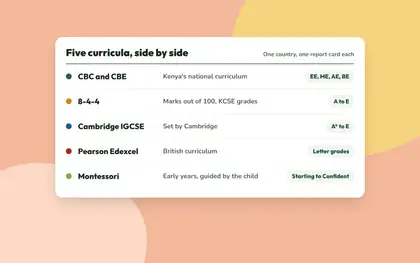
You will hear several names for the same idea: British curriculum, UK curriculum, English National Curriculum, or simply “Year 1 to Year 13” schools. For how it sits beside CBC/CBE, 8-4-4, Cambridge and Montessori, see our guide to the curricula in Kenya.
British curriculum structure: key stages and years
The UK Government sets out the stages like this:
| Stage | Ages | Year groups | Tests in England |
|---|---|---|---|
| Early Years Foundation Stage | birth to 5 | Reception is the year from 4 to 5 | Reception baseline and the EYFS profile |
| Key Stage 1 | 5 to 7 | Year 1 and Year 2 | Phonics screening check in Year 1 |
| Key Stage 2 | 7 to 11 | Year 3 to Year 6 | Times tables check in Year 4, national tests in Year 6 |
| Key Stage 3 | 11 to 14 | Year 7 to Year 9 | None set nationally |
| Key Stage 4 | 14 to 16 | Year 10 and Year 11 | Most take GCSEs |
Schools that teach A level usually add two more years after Key Stage 4, often called Year 12 and Year 13, or sixth form.
The national tests in England are for schools in England. British curriculum schools in Kenya are not part of them, so most use their own tests in the primary years, or programmes from an international board. The first external exam most learners in Kenya sit is the International GCSE or IGCSE at the end of Key Stage 4.
What do learners study at Key Stage 3 and 4?
In England, Key Stage 3 covers English, maths, science, history, geography, a modern foreign language, design and technology, art and design, music, physical education, citizenship and computing. At Key Stage 4 the core is English, maths and science. Kenyan schools adapt these lists, so ask for the school’s own subject plan.
Pearson Edexcel International GCSE
Pearson is a UK education company, and Edexcel is the name of its exam qualifications. Its International GCSE is designed for international learners aged 14 to 16. Pearson says it is studied in over 80 countries and is available in 37 subjects, including options such as Further Pure Mathematics.
Key facts for parents:
- Grading: 9 to 1, where 9 is the highest grade.
- Exam series: May to June, and November, each year.
- Assessment: Pearson now offers a choice of linear (all exams at the end) or modular assessment for many International GCSE subjects. Ask the school which route it uses.
- Where it leads: International A level, other A levels, or other post 16 courses.
How does 9 to 1 compare with A* to G?
Pearson’s own chart says the bottom of grade 7 broadly lines up with the bottom of an A, the bottom of grade 4 with the bottom of a C, and the bottom of grade 1 with the bottom of a G. Grade 9 was added to mark out the very top performers. So a 7 is roughly an A, and 8 and 9 sit above it.
Pearson for the younger years
Pearson calls its route for international schools iProgress: iPrimary, iLowerSecondary, International GCSE and International A level, covering ages 5 to 19. A British curriculum school in Kenya may use these, Cambridge programmes, or its own tests in the years before International GCSE.
Pearson Edexcel International A level
Edexcel’s International A level (often written IAL) is taken after International GCSE or IGCSE, usually over two years. Pearson offers it in 21 subjects and says UK NARIC has confirmed it is comparable to the A level taken in England.
- Grading: the full International A level is graded A* to E. International AS is graded A to E.
- Exam series: January, May to June and October, though not every subject is offered in every series.
- Modular: in every subject except Law, learners sit exams unit by unit, when they are ready or all at the end. Units can be resat to improve the overall grade, and Pearson says a resit is not shown on the results statement.
When are Edexcel A level results released? According to Pearson’s guidance for universities, results for the October series come out in January, for the January series in March, and for the May to June series in August. Final certificates follow some months later.
Pearson Edexcel vs Cambridge: what is the difference?
Both boards are well known and their qualifications are accepted by universities. The differences that matter most to Kenyan families:
| Pearson Edexcel | Cambridge | |
|---|---|---|
| At age 14 to 16 | International GCSE, graded 9 to 1 | IGCSE, graded A* to G worldwide (9 to 1 offered only in one Cambridge zone) |
| IGCSE assessment | Linear or modular in many subjects | At the end of the course, with Core or Extended papers in many subjects |
| A level | Modular units, three exam series a year, resits by unit | AS and A level, with a staged route where AS is sat first in many subjects |
| Exam series | International GCSE: May to June and November. IAL: January, May to June, October | June and November |
| Results | IAL: January, March and August | August and January |
| Younger years | iPrimary and iLowerSecondary, or the British National Curriculum | Cambridge Primary and Lower Secondary |
Neither is better for every learner. One who does well with exams spread through the course may like Edexcel’s modular A level. A school’s choice often depends on its teachers and subjects, and some schools use Edexcel for some subjects and Cambridge for others.
For more on Cambridge grading and results dates, read Cambridge IGCSE in Kenya.
How Kenyan schools use the British curriculum
Schools in Kenya combine these pieces in different ways:
- Fully British: Early Years and Key Stages 1 to 3, then Edexcel or Cambridge exams at Key Stage 4 and A level.
- British primary, international exams: the national curriculum for England in primary, then Cambridge IGCSE or Edexcel International GCSE.
- Dual curriculum: CBC/CBE in one track and the British curriculum in another, sometimes on the same campus. Our guide to one school system for several curricula covers how those schools keep records straight.
How to check a British curriculum school in Kenya
- Ask which board’s exams your child will sit in each subject.
- Check the centre with Pearson’s international centre search (it lists only centres that agreed to be listed) or Cambridge’s “Find a Cambridge school”.
- Ask whether International GCSE is linear or modular, and what the school teaches before Year 10.
University entry in Kenya with Edexcel
Kenyan universities admit learners with British qualifications once KNEC has equated them. KNEC’s guidelines of April 2025 say:
- To equate a certificate to KCSE, the learner must have taken at least seven subjects, including Mathematics, a language and any five others.
- To equate an A level certificate, the learner must also send the matching O level (International GCSE or IGCSE) certificate and must have at least a Division II at O level or a KCSE mean grade of C (plain).
- The exam board confirms the results directly to KNEC, and applications go through KNEC’s online QMIS platform.
KNEC warns that its rules may change without notice. Each university then applies its own entry grades; the University of Nairobi lists IGCSE and GCE among the international qualifications it treats as equivalent to KCSE for degree entry. Check with KNEC and the university early, before subjects are chosen. If your child may move between systems, read moving from CBC to IGCSE, and back.
How Enaton helps
Enaton runs Pearson Edexcel and the British curriculum on their own terms: key stages and Year groups, International GCSE and A level grading, and termly report cards parents can read. If you also run CBC/CBE or Cambridge, every curriculum shares one learner register, one fee system and one parent account per family. Head teachers can see what Enaton does for the whole school, and parents can see what Enaton gives families. See the British curriculum school management system, or book a demo. Want this at your child’s school? Share this guide with the head teacher, or tell them about Enaton.
Still deciding? Read which curriculum is best for my child.
Frequently asked questions
What is the British curriculum in Kenya?
The national curriculum for England, taught by some private and international schools in Kenya, usually leading to Pearson Edexcel or Cambridge exams at age 16 and A level after that.
Is Edexcel the same as the British curriculum?
Not exactly. The British curriculum says what children learn at each key stage. Pearson Edexcel is an exam board that sets International GCSE and International A level exams many British curriculum schools use.
Is Edexcel IGCSE graded 9 to 1?
Yes. Pearson Edexcel International GCSE is graded 9 to 1, with 9 the highest. Cambridge IGCSE, a different qualification, is graded A* to G around the world.
Is 7 an A in Edexcel IGCSE?
Roughly. Pearson says the bottom of grade 7 broadly lines up with the bottom of an A, and the bottom of grade 4 with the bottom of a C.
Edexcel vs Cambridge: which is better?
Neither is better for everyone. Both are accepted by universities. Edexcel’s International A level is modular with three exam series a year; Cambridge runs June and November series, with a staged AS route in many subjects.
When are Edexcel results released?
For International A level, October series results come out in January, January series results in March and May to June series results in August. Your school releases them to you.
Sources
- UK Government, The national curriculum (key stages, ages, year groups and tests): gov.uk
- UK Government, The national curriculum: Key stage 3 and 4: gov.uk
- UK Government, Early years foundation stage: gov.uk
- Pearson, Edexcel International GCSEs (series, linear or modular, iProgress): qualifications.pearson.com
- Pearson, About International GCSEs (37 subjects, ages 14 to 16): qualifications.pearson.com
- Pearson, International GCSE 9 to 1 grading scale: qualifications.pearson.com
- Pearson, Edexcel International Advanced Levels (21 subjects, series): qualifications.pearson.com
- Pearson, About Edexcel International Advanced Levels (modular except Law): qualifications.pearson.com
- Pearson, International A level and A level guidance for universities (grading, results months, resits): qualifications.pearson.com
- Pearson, Find an international centre: qualifications.pearson.com
- Cambridge International, Cambridge IGCSE grading choice: cambridgeinternational.org
- Cambridge International, AS and A Level qualification: cambridgeinternational.org
- Kenya National Examinations Council, “Guidelines on Equation of Foreign Certificates”, 2 April 2025 (archived copy): web.archive.org
- University of Nairobi, “Procedure for Equation of Foreign Qualifications” (admission criteria): uonbi.ac.ke