To reduce school fees arrears, make it easy to know what is owed, easy to pay, and predictable what happens if a family falls behind. In practice that means one clear fee structure per class, reminders that quote each family’s live balance, written clearance rules applied the same way to everyone, and agreed payment plans that the school actually follows up.
Quick answer: Arrears fall when the fee structure is clear before term starts, payment is easy by M-Pesa and bank, reminders are accurate and well timed, clearance rules are fair and consistent, and payment plans are recorded and tracked. Most arrears problems are information problems before they are money problems.
Why school fees arrears build up
Some families genuinely cannot pay on time. But much of the arrears in Kenyan schools grows from things the school controls:
- Parents are not sure what they owe. Extra charges appear mid term, or last term’s balance was never stated.
- Payments are not matched to the right learner, so a family who paid looks like a defaulter and stops trusting the statement.
- Reminders go to everyone, including families who have already paid, so parents learn to ignore them.
- Clearance rules change from week to week or depend on who is at the gate.
- Payment promises are made verbally and nobody follows up when the date passes.
Fix these and the arrears that remain are the real ones.
Step 1: Publish a clear fee structure before term opens
Every family should know, before the first day, exactly what the term costs for their child:
- tuition and each other charge, by class, on one page
- optional items (transport, lunch, boarding, trips) shown separately, with their own amounts
- the payment deadlines for each instalment, if you allow instalments
- the school’s Paybill and bank details, and the exact account number to use
Then bill every learner against that structure on day one, so each family has an opening balance. A parent who has a figure in writing is far more likely to pay it than one waiting to be told.
Charge only what has been approved. In July 2026 Education CS Julius Ogamba said principals were facing disciplinary action over unauthorised levies, and that a levy should not be charged unless it has gone through the required process, been accepted by parents and been cleared under Ministry protocols.
Step 2: Make paying easy, and make every payment land on the right child
Most Kenyan parents pay by M-Pesa, and many pay from a bank. Accept both, and tell parents plainly which reference to use: usually the learner’s admission number. Our guide on how to pay school fees using M-Pesa is written for parents, and you are welcome to share it.
A parent who can see the balance without ringing the office pays sooner and disputes less. If your school has a parent portal, show every family how to use it; our guide to what a school parent portal is explains it in plain terms for parents.
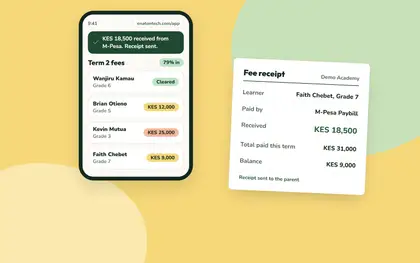
The other half is posting. When the bursar matches M-Pesa messages and bank slips by hand, payments sit unposted for days and some land against the wrong child. Each delay creates an arrear that is not real, and a parent chased after paying is harder to collect from next time.
Step 3: Send reminders that quote the live balance
A reminder works when it is accurate, specific and polite. A better reminder:
- names the learner
- states the balance as it stands at the moment of sending
- gives the Paybill, the account number and the deadline
- goes only to families who actually owe
Timing helps too. A reminder a week before a deadline, another on the day, and a personal call afterwards works better than daily blasts. Avoid late night messages, and stop the moment a family pays.
A sample school fees reminder SMS
Keep it short enough for one SMS, and fill in the details for each family:
Dear parent, the fee balance for [learner name], [class], is KES [balance] as at [date]. Please pay by [deadline] to Paybill [number], account [admission number]. If you have paid in the last day, thank you and please ignore this message. [School name], [phone].
For a missed instalment, send a personal message instead: the plan, the missed date, the amount, and an offer to call.
Step 4: Write down clearance rules, and apply them the same way to everyone
Clearance, the rule about when a learner may sit exams or collect a report card, is the most sensitive tool a school has. Used badly it punishes the learner for the parent’s arrears.
Good clearance rules are:
- written and shared with parents at the start of the year
- based on a threshold, such as a percentage of the term’s fees, rather than a feeling
- applied the same way whoever is on duty at the gate
- checked against today’s balance, not a list printed last week, so a learner whose parent paid this morning is not sent home
Follow Ministry of Education and county guidance on sending learners home. In January 2026, as Grade 10 learners reported to senior school, the government warned school heads against sending learners home over fees, The Standard reported. Public schools in particular should take this seriously.
Can a school withhold a certificate over fees arrears?
No. In March 2025 Education CS Julius Ogamba said it is illegal for schools to withhold the certificates of learners who have completed their exams, and directed heads to release withheld KCPE and KCSE certificates. In October 2026 he warned again that principals who unlawfully withhold KNEC certificates over unpaid fees could face disciplinary and legal action. Pursue an old balance through lawful channels, never through a former learner’s certificate.
Step 5: Offer payment plans, and track them
A family that agrees a plan and keeps to it is not a defaulter. Treat them differently:
- Agree the plan in writing: amounts and dates.
- Record it against the learner, so reminders do not chase them while the plan is being kept.
- Follow up on the date. A missed instalment needs a call within a day or two, not at the end of term.
Partial payments should be welcome. A parent who can send a few thousand shillings every fortnight should be able to, with each payment receipted and the balance updated.
Where a family genuinely cannot pay, point them to any bursary or scholarship they may qualify for, and keep a record of the conversation.
Step 6: Know your numbers every week
Directors and bursars should be able to answer, on any Monday:
- How much has been billed this term, and how much collected?
- Which classes and which families make up most of the balance?
- Which payment plans are on track, and which have slipped?
If the answers take a day of spreadsheet work, the school is managing arrears a month late.
Public schools should also watch KEMIS: capitation is worked out from the learner records there, so a missing learner is missing income. See what KEMIS is.
What not to do
- Do not chase a parent who has paid. Nothing destroys trust in the statement faster.
- Do not publish defaulters’ names on notice boards or in group chats. It shames the child and invites complaints.
- Do not let staff accept fees in cash or to personal numbers. Money that does not reach the official account cannot be receipted or traced.
- Do not change rules mid term without telling parents in writing.
How Enaton helps
Enaton is a school management system that runs the whole school, and its fee compliance engine turns the steps above into work that runs every day, without the bursar chasing by hand.
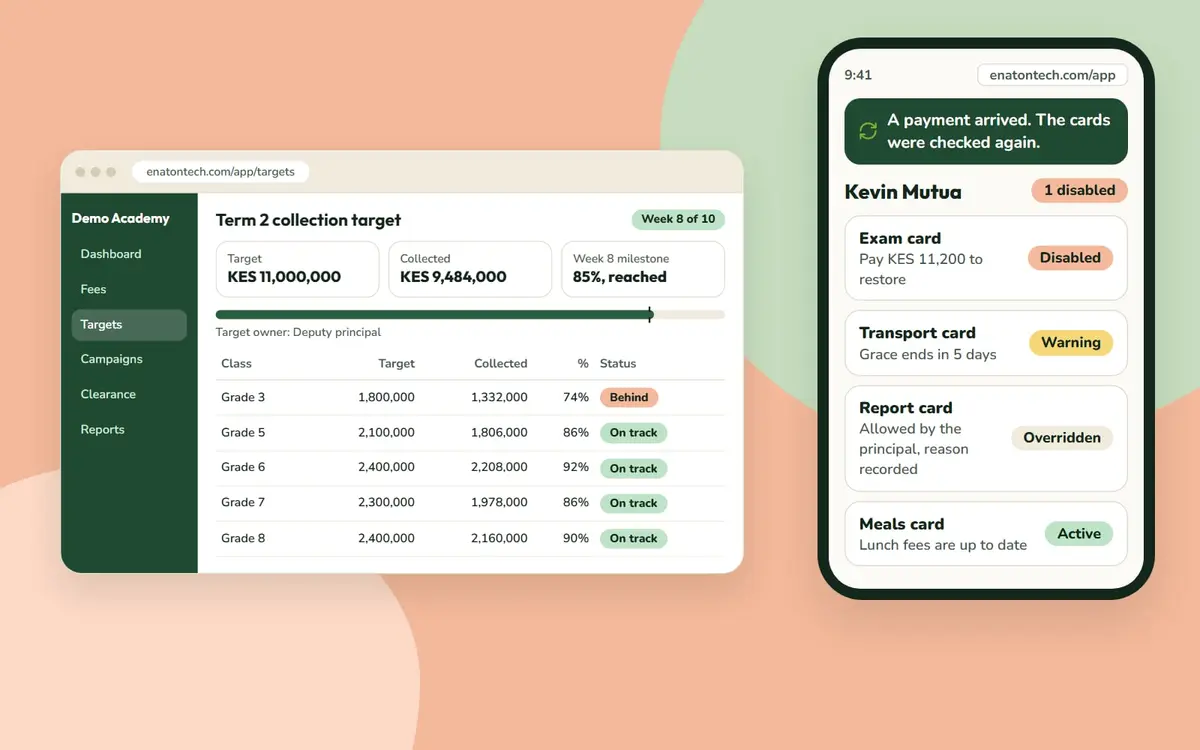
- Set a target for the term, for the whole school, a class or a fee category such as transport, with weekly milestones and an owner. The director hears automatically if one falls behind.
- Run a collection campaign. Every family in it gets their own live balance and the deadline, then reminders on your schedule, never two competing asks for the same fees.
- Let rules and clearance cards do the chasing. Write your clearance policy once as rules, with grace periods. Each learner’s cards (exam, report card, transport, meals and any you create) stay active, in warning, disabled or exempt, and any override needs a recorded reason.
- Accept pledges and plans. Parents request a pledge from the parent portal and the school approves it. A family keeping to its plan keeps its cards; an overdue pledge raises an alert.
- See progress live, collected against target by class and by milestone.
Parents pay by M-Pesa or from any bank in Kenya, and the payment reaches the school in real time, on the right child’s account. Every payment re-checks the learner automatically, so a card comes back on its own the moment enough is paid. Parents see the exact amount to pay by SMS, in the parent portal and by email. Bursars can see how Enaton works for bursars, and directors how it works for school owners. See school fee collection and clearance, school fee management, or book a demo.
FAQ
What are school fees arrears?
School fees arrears are fees billed to a learner that remain unpaid after the due date, including balances carried over from earlier terms.
How can a school reduce fees arrears quickly?
Start by making sure every payment is posted to the right learner and every family has an accurate balance. Then send reminders only to families who owe, quoting the live balance, and follow up personally on the largest balances.
Should a school send learners home for fees?
The Ministry of Education has warned school heads against it, including in January 2026 as Grade 10 learners reported. Follow Ministry and county guidance. If your school uses clearance rules, write them down, share them with parents, and check them against the current balance rather than an old list.
What should a school do when a parent overpays fees?
Record the extra as a credit on the learner’s account, tell the parent in writing, and either carry it to the next term or refund it, as the parent prefers and your policy allows. Never leave it unrecorded.
How do payment plans help with school fees collection?
A recorded plan turns an open ended debt into dated instalments the school can follow up. Families on a plan they keep should not be treated as defaulters or sent general reminders.
Sources
- The Star, report on the Education CS directing schools to release withheld certificates, 17 March 2025: the-star.co.ke
- Education News, “CS Ogamba warns principals against withholding KNEC certificates, threatens disciplinary action”, 12 October 2026: educationnews.co.ke
- The Standard, “Government warns principals against flouting fees directive”, 26 January 2026: standardmedia.co.ke
- Kenyans.co.ke, “Education CS Ogamba Warns Principals Against Illegal School Levies”, 19 July 2026: kenyans.co.ke